Short answer
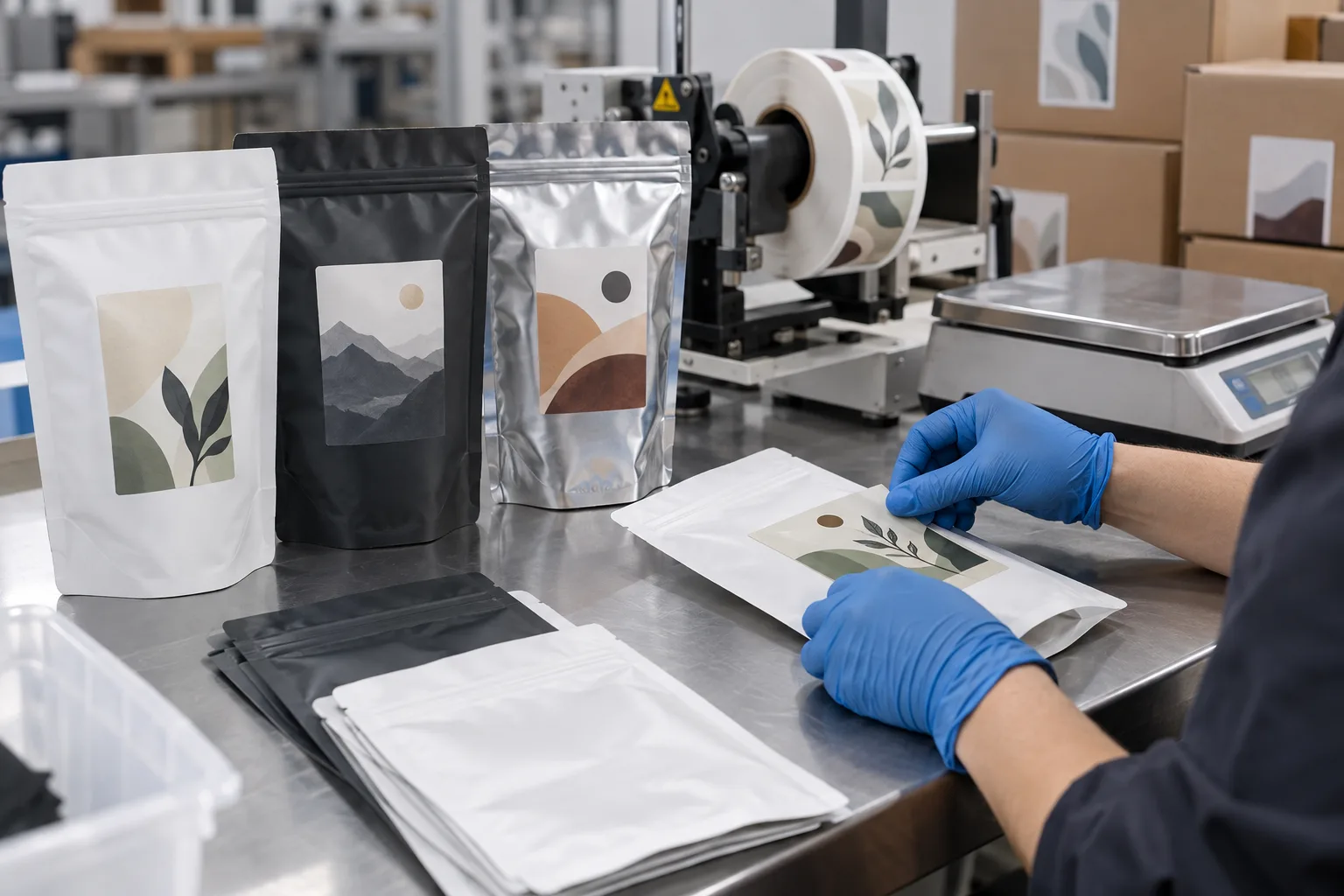
Measure a stand-up pouch after it is filled, then keep the label inside the stable center panel. Do not size the label from the supplier's overall pouch dimensions. Zippers, side seals, bottom gussets and product volume reduce the area that stays flat.
This is why pouch labels sometimes wrinkle even when the material and adhesive are reasonable. The label is asked to bridge a fold that did not exist while the empty pouch was lying on a desk.
Map the pouch before designing the label
| Pouch feature | Label risk | Placement response |
|---|---|---|
| Zipper | Thick ridge and repeated flexing | Keep the label below it with a visible margin. |
| Tear notch | Opening path cuts through artwork | Keep required copy away from the notch line. |
| Side heat seals | Texture and sudden thickness change | End label edges before the seal. |
| Bottom gusset | Panel curves outward when filled | Do not let the main label enter the fold zone. |
| Valve or window | Interference with function or product view | Build the dieline around it intentionally. |
A typical first order: one label size for three pouch sizes
Consider a common planning example: a snack brand uses 100 g, 250 g and 500 g stock pouches and wants one large front label across all three to simplify buying. The idea is efficient. The smallest pouch, however, has almost no margin between the zipper and gusset once filled.
The answer may be two label sizes, not three. The small pouch gets a compact label; the two larger pouches share another. This keeps purchasing manageable without forcing every package into the weakest fit. Standardization is useful only until it starts creating visible failures.
Paper or film on a flexible pouch?
| Condition | Likely direction | Why |
|---|---|---|
| Dry coffee or spice pouch | Paper or film | Both can work if the pouch surface is compatible and stable. |
| Freezer or chilled pouch | Film with reviewed adhesive | Moisture, cold and flexing raise risk. |
| Oily snack handling | Protected film construction | Better resistance to staining and wiping. |
| Metallic pouch with premium design | White, clear or specialty stock after proofing | The pouch color influences clear and translucent artwork. |
The pouch surface matters too. Matte coatings, soft-touch finishes and low-surface-energy films may bond differently. A sample of "the same pouch material" from a different supplier is not always the same application surface.
Labels versus fully printed pouches
Custom labels have a clear advantage for a new range: stock pouches can be shared across flavors, artwork changes are cheaper to absorb and quantities can follow each SKU. Fully printed pouches deserve the win when volume is stable, the package specification is settled and labeling labor becomes a meaningful bottleneck.
I would not push a young brand into printed pouch inventory just to make the package look established. I also would not keep a mature, high-volume line on hand-applied labels because that was the cheapest launch method two years ago. The right answer changes as the operation changes.
Our view
Do not design across movement
A flexible package will never behave like a carton. Give the label a stable island and let the rest of the pouch move.
The best pouch label often looks slightly smaller in the artwork file and much better in the customer's hand.
Stand-up pouch label checklist
- Provide an empty and filled pouch photo with a ruler.
- Measure the flat panel below the zipper and above the gusset.
- Identify the pouch film and surface finish if available.
- State dry, cold, frozen, oily or humid storage conditions.
- Confirm hand or machine application and roll requirements.
- Plan barcode placement on the flattest scannable area.
- Test the label after filling, sealing, shipping and repeated opening.
For the investment decision, compare stock packaging with labels vs fully printed packaging. For mixed flavors, use the multi-SKU short-run guide.
Frequently asked questions
What label material is best for stand-up pouches?
Film labels are often chosen for flexible, moisture-prone or heavily handled pouches. Paper can work on dry, smooth pouches when the package and storage conditions are stable.
Where should a label go on a stand-up pouch?
Place it on the flattest front or back panel, below the zipper and away from heat seals, tear notches, gusset folds and strong curves created by the product.
How big should a pouch label be?
Measure the usable flat panel on a filled pouch, not the overall empty pouch dimensions. Leave a visual and mechanical margin around seals, edges and folds.
Are labels better than printed pouches?
Labels are often better for tests, short runs and multiple SKUs. Fully printed pouches can be more efficient when artwork, demand and package dimensions are stable at higher volume.
Related label guides
- Hot-Fill Bottle Labels: Heat, Timing and Adhesive Guide
- Labels for Squeeze Bottles: Prevent Creases and Edge Lift
- Clear Labels on Dark Bottles: When White Ink Matters
If the label must become a working closure, read the peel-and-reseal food label guide.
Test the specification before bulk production
Send the package photos, finished label size, quantity by artwork, storage conditions and application method. We will review the practical fit before preparing a quote and digital proof.
Continue with Stand-Up Pouch Label Placement: Keep Clear of the Zipper and Seal for a focused purchase checklist.