A label that peels from a newly prepared sample may not represent the later removal job. The buyer may expect a consumer to remove it by hand after storage, or a business may plan a defined washing process. Those are different briefs.
Specify when, how and by whom the label must be removed, alongside what it must withstand beforehand. The adhesive name alone cannot establish that full sequence.
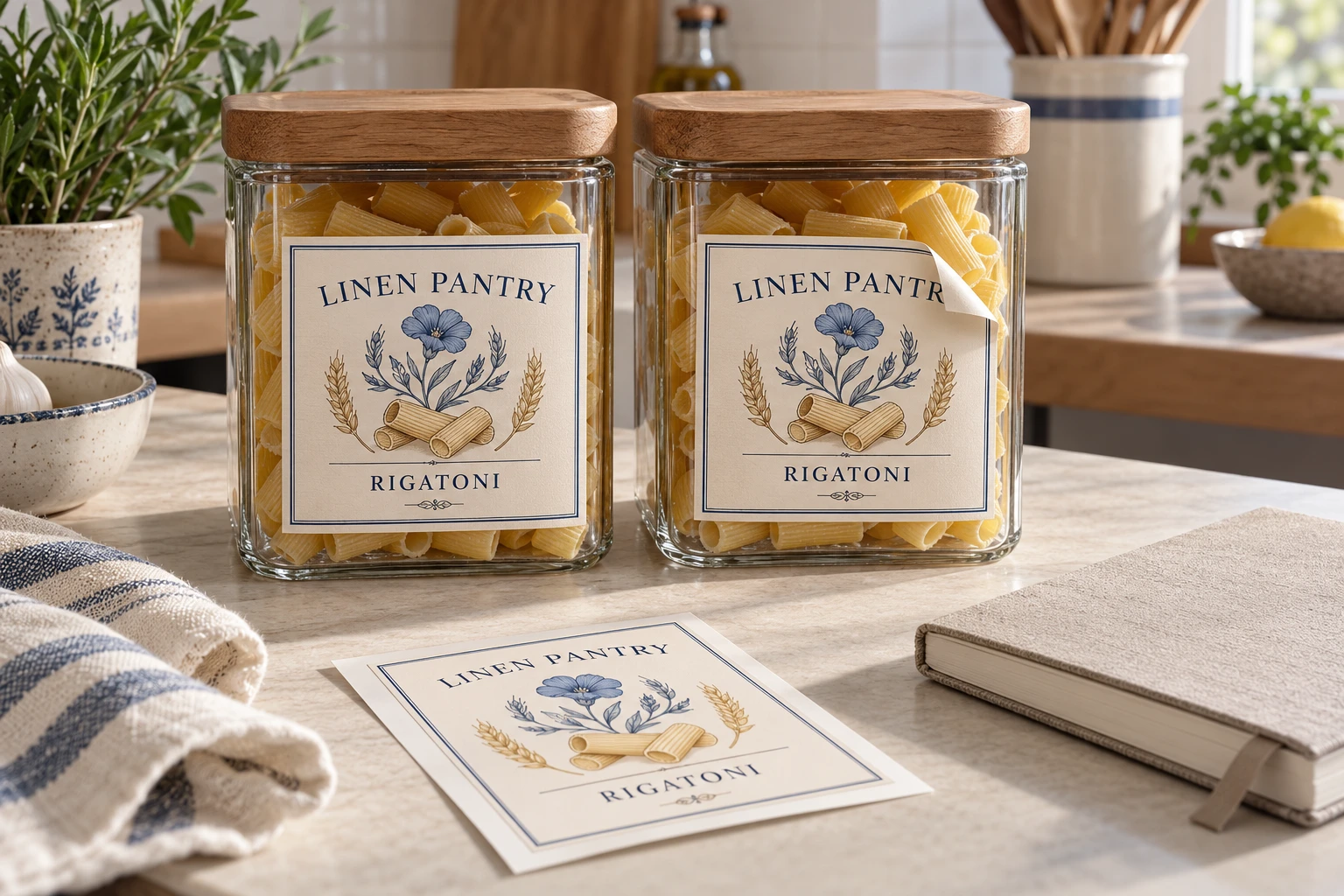
AI-generated packaging planning example. Linen Pantry is a fictional brand; not a customer project, production test or usable retail artwork.
Write the removal event in ordinary words
Identify the external surface, intended time in use, relevant storage and the person or system performing removal. If these inputs are unknown, keep the result provisional. Do not invent a dwell time or chemical process to make a sample pass.
| Lifecycle field | Requirement or observation to agree |
|---|---|
| Initial application | Actual surface, construction and labeling conditions |
| Holding period | Intended use interval and exposures represented by the sample |
| Removal method | Hand peel or a separately specified industrial process |
| Surface condition afterward | Agreed residue, damage and appearance observations |
| Label behavior | Tearing, fragmentation or intact removal as relevant |
| Reuse objective | What the business intends to do next with the container |
The record is an editorial brief, not a universal removal test. Ask the material supplier which evidence and conditioning are relevant to the proposed construction. Keep sample and package identities so observations are not generalized to every surface called glass or plastic.
Treat repositioning and later removal separately
An adhesive that permits adjustment shortly after application does not automatically promise clean consumer removal much later. Likewise, a label intended to remain through distribution may need a specific later removal route. Confirm the actual behavior being offered.
UPM's removable-adhesive overview describes different removable, repositionable and reclosure applications. These manufacturer categories illustrate why the use sequence matters; they are not interchangeable performance guarantees for this site's supply.
Observe the surface and the label separately
Record whether the label remains readable and attached during use, then record what happens during removal and what remains afterward. A label coming away in one piece is not, by itself, proof that the surface is undamaged or residue-free. A photograph can document appearance, but the agreed inspection method should define what the buyer actually accepts.
If clean removal is essential from a coated or decorative package, test the actual supplied surface. Avoid introducing unapproved solvents or heating steps just to achieve the desired appearance. Those changes may fall outside the intended user behavior or the packaging system's instructions.
For industrial returnable-bottle washing, use the wash-system owner's process. For liner release, use the separate dispensing discussion. For a label that must stay attached, use the peeling investigation. These are different separations with different evidence.
Short answer
Choose permanent adhesive for most retail food and beverage labels that must stay on through storage, handling and sale. Choose removable adhesive when the label is temporary, promotional, applied to reusable containers or should come off with less residue.
Removable vs permanent adhesive comparison
| Decision point | Removable adhesive | Permanent adhesive |
|---|---|---|
| Best use | Temporary labels, promotions, reusable jars, short campaigns and removable stickers. | Retail packaging, bottle labels, food jars, beverage labels and long-term product identification. |
| Removal | Designed for cleaner removal under suitable conditions. | Designed to stay attached; removal may leave residue or damage the label. |
| Retail durability | Usually not the first choice when the label must survive rough handling. | Usually safer for normal product packaging. |
| Wet or cold use | Needs careful review; removable does not automatically mean waterproof. | Still needs matching material and adhesive for wet or cold surfaces. |
| Risk | May lift if the package needs strong long-term adhesion. | May be too aggressive if clean removal is the goal. |
When removable adhesive makes sense
Removable labels can work for temporary price stickers, seasonal promotion labels, sample labels, returnable containers, reusable storage jars or campaign stickers. They are not automatically suitable for every package, so the surface and removal expectation should be discussed before printing.
When permanent adhesive is the safer default
Most product labels need to stay on through filling, packing, shipping, retail handling and customer use. Permanent adhesive is usually the safer default for sauce bottles, honey jars, beverage bottles, wine bottles, cans, food containers and freezer or chilled packaging when matched with the right material.
What affects adhesive performance?
| Field | Requirement to confirm |
|---|---|
| Surface | Glass, PET, HDPE, metal, paperboard or flexible pouch film. |
| Environment | Dry shelf, cold storage, freezer, wet handling or oily product area. |
| Shape | Flat panel, tight curve, taper, ribbed bottle or textured jar. |
| Application | Clean surface, correct pressure and suitable temperature during labeling. |
Related guides
If labels are peeling, read why bottle labels peel off. For chilled drinks, compare waterproof beverage labels. For size and curve issues, use the label size guide.
Report the limit of a successful sample
When a sample meets the agreed observation, state the package surface, elapsed use period and removal method that result represents. Do not report only that the label is removable. If a second container supply has a different coating or finish, keep it as a separate unresolved condition until the responsible reviewer accepts relevant evidence. This makes a successful sample useful without turning it into a promise for every reusable container.
Send the relevant project details
Send the intended label-removal brief with the package surface, label size, quantity, holding conditions and actual removal method. State what residue or damage observations matter. The form opens an email draft; use listed email or WhatsApp for files. Ask which construction and sample plan can be confirmed for that sequence.