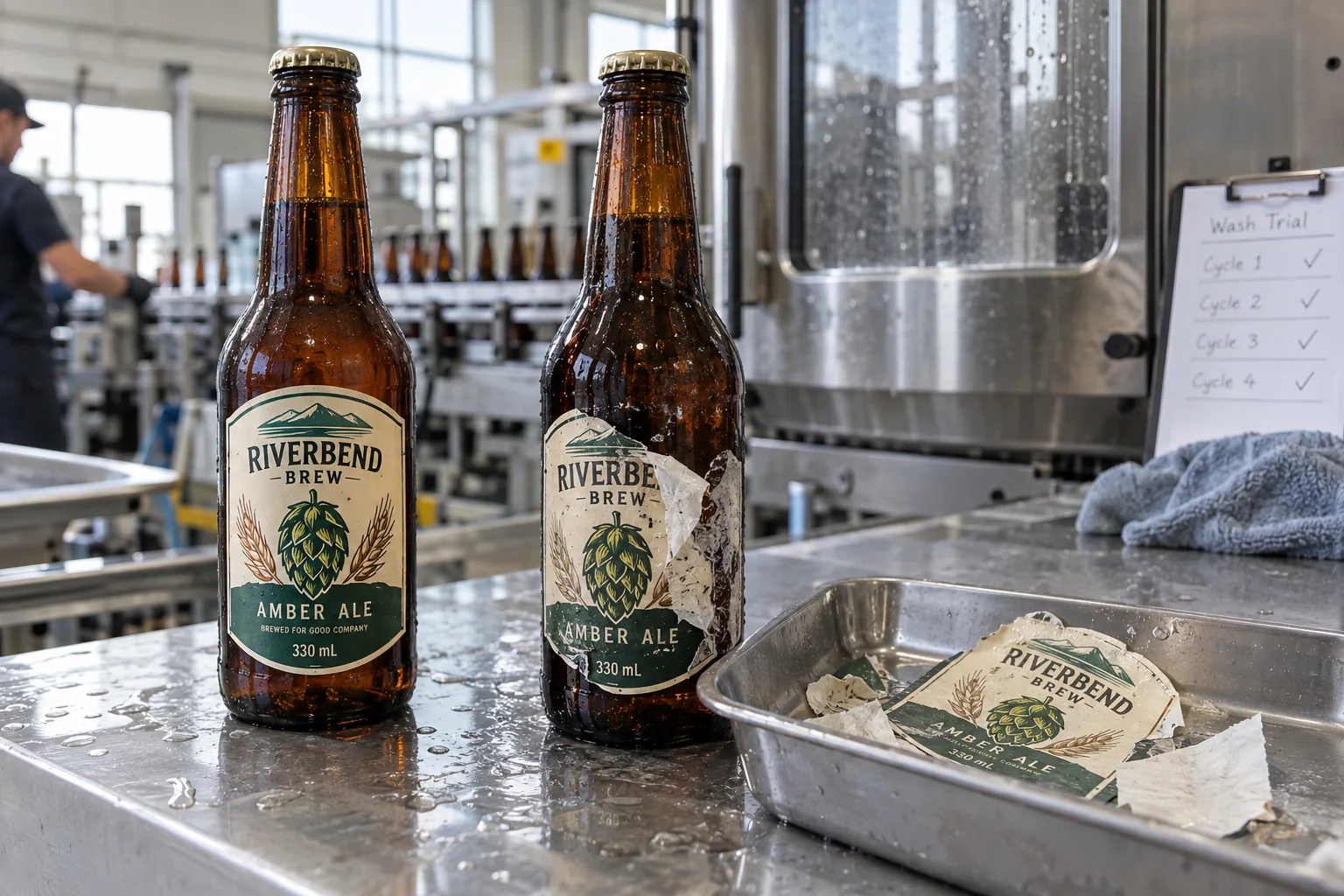
First decide what happens to the empty bottle
When a buyer asks me for a 'recyclable glass label,' my next question is whether the bottle is reused. One-way glass is sorted and processed as material. A returnable bottle must be recovered, cleaned and filled again. The labels may therefore need different release behavior even when they look identical on the shelf.
UPM's packaging guidance distinguishes label solutions for glass recycling from wash-off solutions for reusable bottles. I would treat those as separate purchase briefs, not substitute one environmental phrase for the other.
Two brewery buyers can share artwork and need different stock
Imagine a composite brewery selling an amber ale in one-way glass. Its main concern is appearance through chilled distribution and compatibility with its intended disposal route. A returnable-bottle program buys the same front artwork, but its bottles travel back to a washer. The second buyer needs the label to withstand ordinary sale and handling, then leave the bottle under an agreed industrial wash process.
Neither buyer should accept an unqualified 'eco label' claim. The returnable system has an operator, defined equipment and a cleaning specification. If we do not know those details, I would not promise wash-off performance.
The brief has two opposing jobs
| Stage | What the label must do | Evidence to request |
|---|---|---|
| Application and filling | Apply consistently to the specified bottle | Trial on the actual line |
| Sale and use | Stay readable during expected chill and handling | Finished-bottle observation under relevant conditions |
| Collection | Remain identifiable as bottles return | Handling-route review |
| Bottle washing | Release as required without unacceptable residue | Wash-cycle trial with the system owner |
Record bottle surface, label dimensions, face stock, ink and finish, adhesive, application conditions and the proposed wash cycle. Ask the bottle-washing operator how it evaluates cleanability and rejects bottles. Do not invent a universal water temperature or chemical concentration; a supplier's claim needs to match the system that will actually run the bottles.
Test the whole decorated bottle
A printed sheet in a beaker is not the same as a label that has aged on a filled bottle. I would request production-like labeled bottles, after representative storage and handling, for a wash trial. Observe label detachment, fragments, residue and the bottle's condition afterward. The brewery and washer should agree what constitutes a pass before the test starts.
UPM's recyclability guide also treats reusable bottle washing separately from single-use glass recycling. It supports asking where the package goes, not making a blanket claim that any particular artwork is recyclable or reusable in every market.
Our buying view
Do not buy a claim the return system cannot use
The attractive shortcut is to specify a material marketed as washable and stop there. I would get the washer's process and acceptance criteria first. The buyer is not purchasing a brochure phrase; it is purchasing bottles that can return to production without unnecessary rework.
Questions to send with an RFQ
- Is the bottle one-way, returnable or used in both channels?
- Who owns the bottle wash specification and trial?
- Which bottle, ink, varnish and label construction will be tested?
- What wet-use and wash-off results must be demonstrated?
- How will changes to the bottle or wash process trigger requalification?
For a different container stream, read wash-off labels for PET recycling. If moisture is the primary issue while bottles are in use, compare our waterproof beverage-label materials.
Frequently asked questions
Do all glass bottles need wash-off labels?
No. A one-way glass bottle destined for recycling and a returnable bottle destined for washing have different label-removal requirements. Confirm the actual collection route.
Does a wash-off label guarantee clean bottles after any wash?
No. Removal depends on the specified label construction and the real washing process. Test the bottle, decoration and wash conditions with the system owner.
Can I use the same label on chilled shelves and a returnable line?
It may be possible with a suitable construction, but both wet-use performance and later removal must be validated. Neither requirement should be assumed from the other.
Related buyer guides
Review your label specification
Send package photos, label dimensions, material details, quantity and application conditions. Include good and failed samples where possible so the discussion starts with evidence.