The sample bottle looks clean. The label is still attached after a night in the refrigerator. Purchasing now has to decide whether that result is enough to release a production order.
It may be enough for the sample's recorded conditions. It says much less when nobody recorded how the label was applied.
Approve the evidence against your actual labeling process before approving the material name. A film described as waterproof does not, on its own, establish that the adhesive will attach to a wet bottle or that the print will tolerate the intended handling. The useful question is which part of the job the sample actually represents.
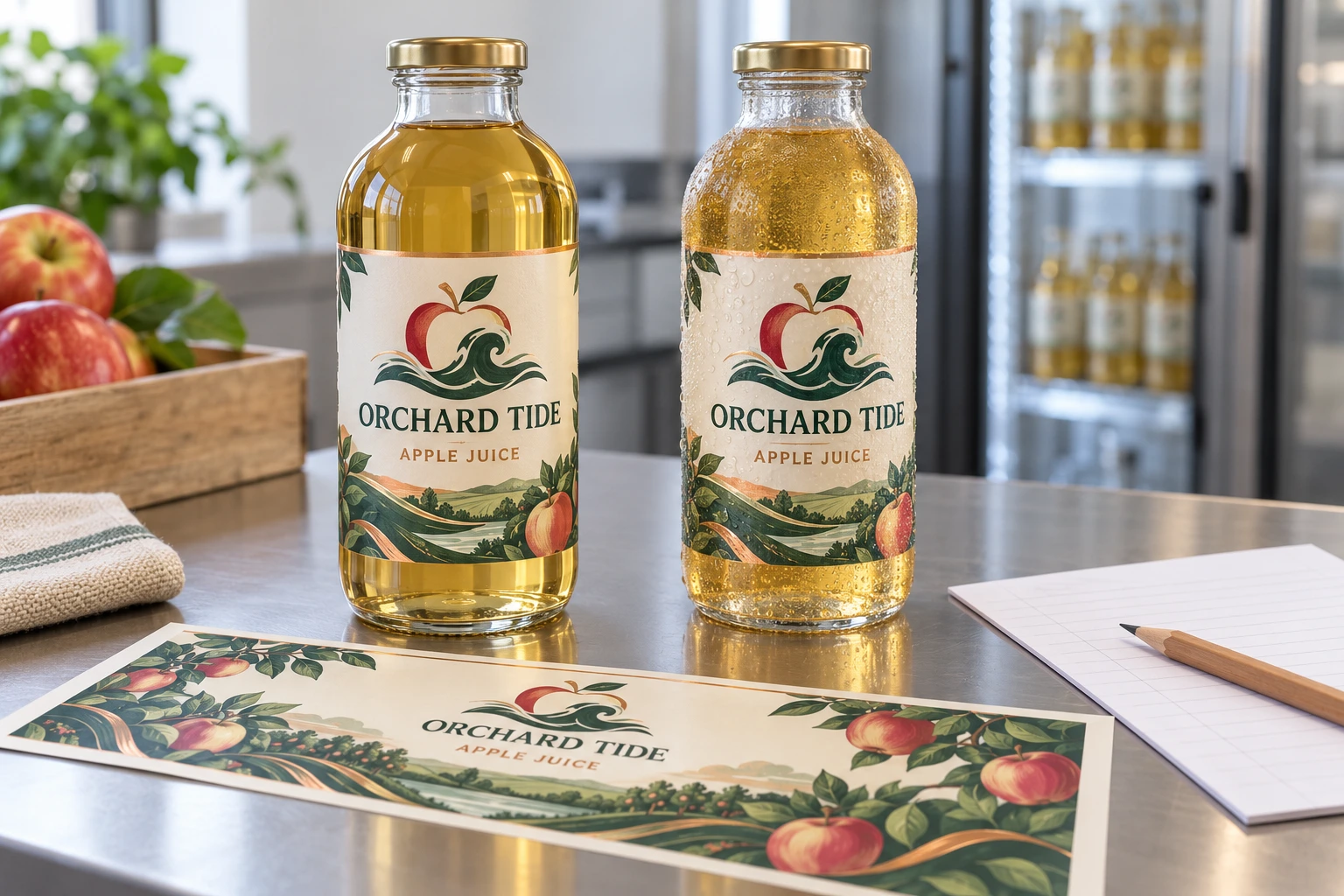
AI-generated packaging example. Orchard Tide is a fictional original brand. The dry and condensed bottles illustrate different conditions; no test, performance comparison or approved material is shown.
Separate the sample story from the production story
Imagine a purchasing review where sample labels were applied to empty, dry bottles at room temperature. The bottles were then filled and chilled. Production, however, labels bottles after cold filling, when visible moisture can be present. This is an illustrative situation, not a reported customer failure.
Those two routes do not provide the same evidence. The first can help investigate appearance after chilling. It does not establish initial application performance on the second route. A photograph of the finished sample cannot recover the missing sequence.
Ask whoever made the sample to write down the steps, including surface condition, application temperature and time between operations. Ask production for the corresponding sequence on the intended line. Put the two records beside each other. A blank field is a question to resolve, rather than permission to assume the conditions match.
For the broader technical distinction, see our glass-bottle condensation guide. Here the purchasing task is narrower: deciding what the sample evidence covers before signing it off.
Use this sample coverage sheet
Copy the following table into the sample request. Keep one column for the actual production route and another for the sample as prepared. Record who confirmed each item and attach the relevant photograph or document.
| Record | Production requirement | Sample evidence to request |
|---|---|---|
| Container | Material, supplier reference, usable panel and surface treatment if known | Actual container identity, or a clearly identified substitute |
| Application surface | Dry, misted or visibly wet at the labeler | Photograph and description when the adhesive first contacted the bottle |
| Application temperature | Bottle-surface and surrounding conditions | Recorded conditions, not simply “refrigerated” |
| Application process | Hand or machine, pressure/contact method and relevant line settings | How the trial label was applied and any differences from production |
| Time between steps | Filling, labeling, packing and exposure sequence | Preparation and inspection times agreed with the testing party |
| Subsequent exposure | Condensation, wiping, splash or immersion actually expected | Which exposure was included, its conditions and what remains untested |
| Construction | Face, adhesive, print and finish proposed for the order | Sample identity and evidence that it represents that construction |
| Acceptance | Appearance, readable information and bond behavior that matter | Recorded observations, retained reference and agreed decision owner |
This is a purchasing record, not a standardized laboratory procedure. Set the exposure, timing, specimen coverage and acceptance limits with the supplier or appropriate testing specialist. Do not fill in convenient numbers and describe them as an industry standard.
Do not let the word waterproof bridge an evidence gap
Avery Dennison's Z3338 technical overview discusses an adhesive designed for cold and condensed bottles. Even that product-specific guidance says surface-water levels and the labeling setup matter. It supports asking about the actual application, rather than treating a cold/wet description as unlimited tolerance. It does not establish a specification for another adhesive or confirm this website supplies that product.
When the line can present consistently dry bottles, a dry-application trial followed by the relevant use exposure can be a sensible starting point. When moisture remains at application, ask for evidence covering that situation or investigate whether the process can provide a suitable surface first. A more expensive face film is not a substitute for resolving that question.
For deep water exposure, use the separate wine ice-bucket material guide to prepare the immersion discussion. Do not silently substitute a brief exterior splash for the customer's intended service conditions.
Keep the material comparison, but change what gets approved
White film offers an opaque print base; clear film makes the bottle and product part of the design. With clear material, evaluate the actual filled package, including contrast and the proposed white-ink areas. A screen viewed on a white background is a different presentation.
Paper-based constructions may serve a desired tactile appearance. If moisture is involved, identify the particular paper, adhesive and protective treatment and request relevant evidence for the complete printed sample. Calling paper laminated or wet-strength does not settle every end-use condition. Likewise, BOPP or PET names alone do not specify adhesive, finish or application performance.
Record the reason for each candidate. An opaque face might simplify readability; a different finish might change glare or handling. Neither benefit should quietly become a claim about attachment to a wet surface. Keep appearance approval and functional approval as connected but separate records.
Give each gap a decision and an owner
Mark each row of the coverage sheet as matched, different or unknown. These are review categories, not test grades.
If the container and process match, ask whether the stated observations and acceptance rule are sufficient for the actual risk. If they differ in a way that can affect the result, obtain corresponding evidence or agree a documented additional trial. If the production requirement itself is unknown, have the responsible production person confirm it before asking the printer to choose around an assumption.
Do not convert a provisional appearance approval into a full construction release. A short note such as “artwork approved; wet-application evidence outstanding” is more useful than an unexplained signature. Identify who can close the outstanding item and which sample revision they must reference.
Preserve the record for the reorder
Keep the approved construction reference, sample identity, completed sheet and unresolved exceptions together. Ask for notification when a proposed substitution changes the adhesive, face, finish or other condition behind the evidence. A retained bottle without its preparation history is a weak reference months later.
Roll direction, core and other application-format requirements still belong in the order specification. They do not prove water performance, but a suitable construction in the wrong format can still delay packing. The beverage-label procurement page provides the relevant product context.
Send the missing conditions, not another waterproof request
Send a sample-specification inquiry through the contact page with a bottle photo and material, label dimensions, application-surface condition and temperature, subsequent wet exposure and any existing sample record. Include quantities by artwork when the discussion needs to progress to pricing.
Use the listed email or WhatsApp route for attachments; the form opens an email draft. Ask which construction and evidence can be discussed for those conditions and what still needs confirmation. That gives the next conversation a specific task without pretending that a photograph has already approved the production run.