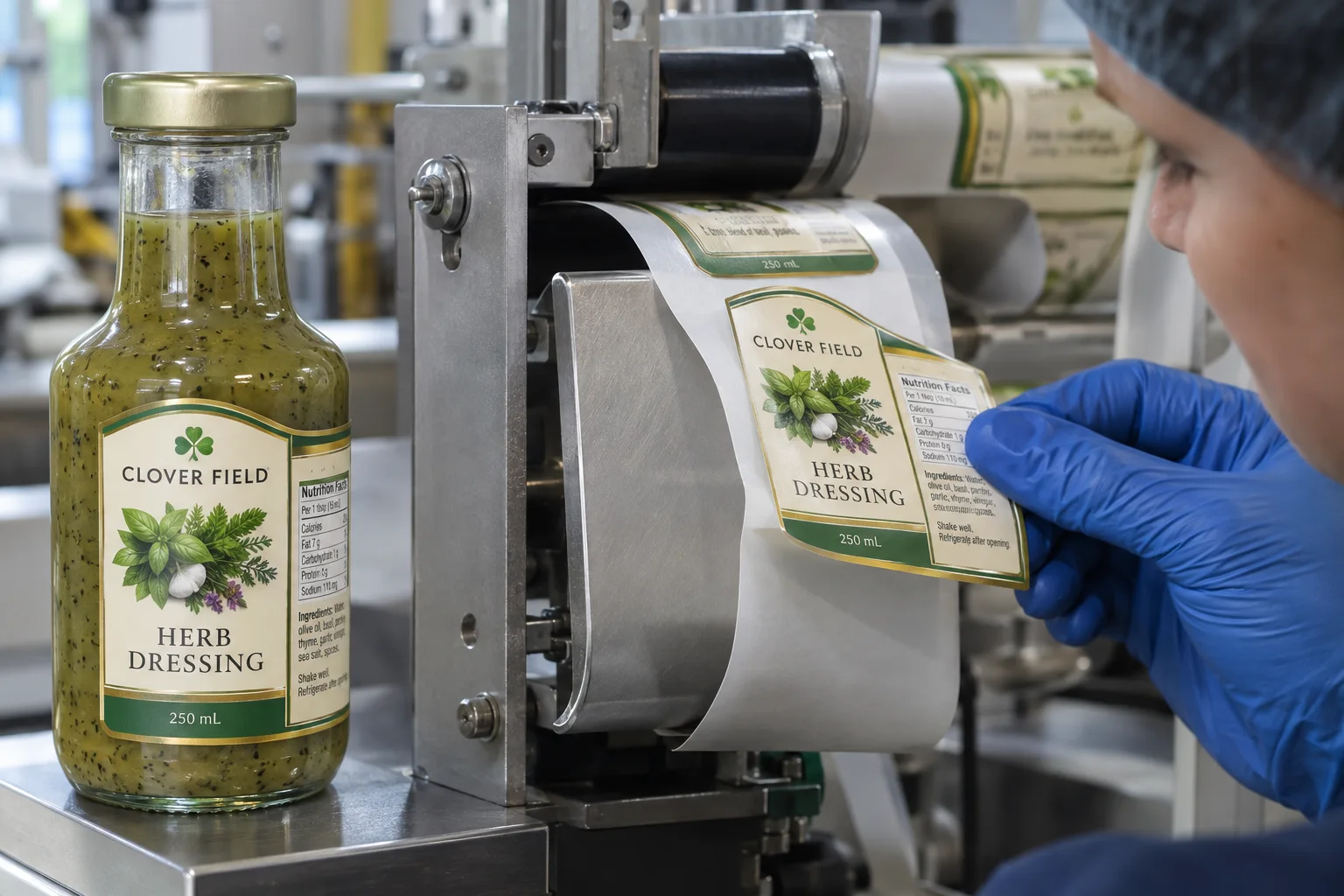
There are two separations in this purchase
Pressure-sensitive labels must leave the release liner and then stay on the package. Buyers often describe both as a glue problem. I would separate them on the workbench: what happens at the peel plate, and what happens after the label contacts the bottle?
Smithers explains release-force testing as measuring the force needed to separate a pressure-sensitive material from its release backing. Too high a release force can interfere with dispensing; too low a force can permit premature separation. That measurement is not the same as the label's adhesion to glass or plastic.
A dressing line that looks like an adhesive complaint
Consider a composite buyer packing herb dressing into glass bottles. Finished bottles keep their labels through handling, but the automatic applicator intermittently carries a label past the peel point. The buyer asks for a stronger adhesive, assuming the label is not 'sticky enough.' I would pause: stronger bond to the bottle does not tell us why the label stays on its liner.
In another composite operation, labels lift from chilled bottles after application while the roll dispenses cleanly. Here liner release is not the leading issue. Package temperature, moisture, surface condition and adhesive suitability need review. The symptoms may arrive in the same email, but the remedies should not be bundled.
Use the failure point to choose a test
| Observed problem | First comparison | Possible interface |
|---|---|---|
| Label remains on backing at peel point | Sound and failing rolls on the same setup | Release system or dispensing setup |
| Label lifts before peel point | Roll path, winding and retained stock | Premature liner separation |
| Label applies but later lifts | Good and failed packages after storage | Package bond or application conditions |
| Matrix pulls labels during converting | Die pattern and retained web | Converting plus release interaction |
These are investigation routes, not diagnoses from one photograph. Keep the roll identification, an unused strip and labeled packages. Note the application speed and where the defect first appears. The line supplier can check the equipment; the converter and stock supplier can evaluate the release construction.
Do not mix test numbers from different methods
Release tests depend on the specified test method and conditions. A number reported without speed, sample conditioning and construction is not a transferable purchasing target. Ask for a method appropriate to the material, and compare like with like. The final decision still needs a dispensing trial on the equipment that will use the rolls.
I would also clarify whether the problem affects the first portion of a roll, every roll in a lot or only stock that has spent time in a warm warehouse. That history may redirect the investigation. Do not change tension, peel geometry and label material at once; otherwise even a successful trial tells little about the cause.
Our buying view
Buy the complete construction, not a stronger adjective
A quote that simply says 'high tack' gives me no assurance about dispensing. I would ask for face material, adhesive, release liner and intended application conditions as one construction. I would rather approve a slightly less impressive-sounding material after a clean line trial than a premium stock that only solves the wrong interface.
What to include with the next sample request
- Package material and surface condition at the time of application.
- Machine type, peel path, operating conditions and failure location.
- Unused material from sound and affected rolls.
- How long labels must perform on the package after application.
- Who will test release, who will test the final package and how results will be recorded.
For backing-material tradeoffs, read glassine versus PET release liners. For a label that dispenses but will not stay attached, continue with why bottle labels peel off.
Frequently asked questions
Is low release force always desirable?
No. Too little resistance may let labels separate before the intended peel point. The useful range depends on the construction and the application method.
Can a label bond well to glass but fail to dispense?
Yes. Release from the backing and adhesion to the glass are different interfaces. Evaluate both on the actual roll, line and package.
Should I specify one release-force number for every label?
No. Ask the material supplier and converter which test method and conditions apply to the chosen construction, then validate dispensing on the intended equipment.
Related buyer guides
Review your label specification
Send package photos, label dimensions, material details, quantity and application conditions. Include good and failed samples where possible so the discussion starts with evidence.