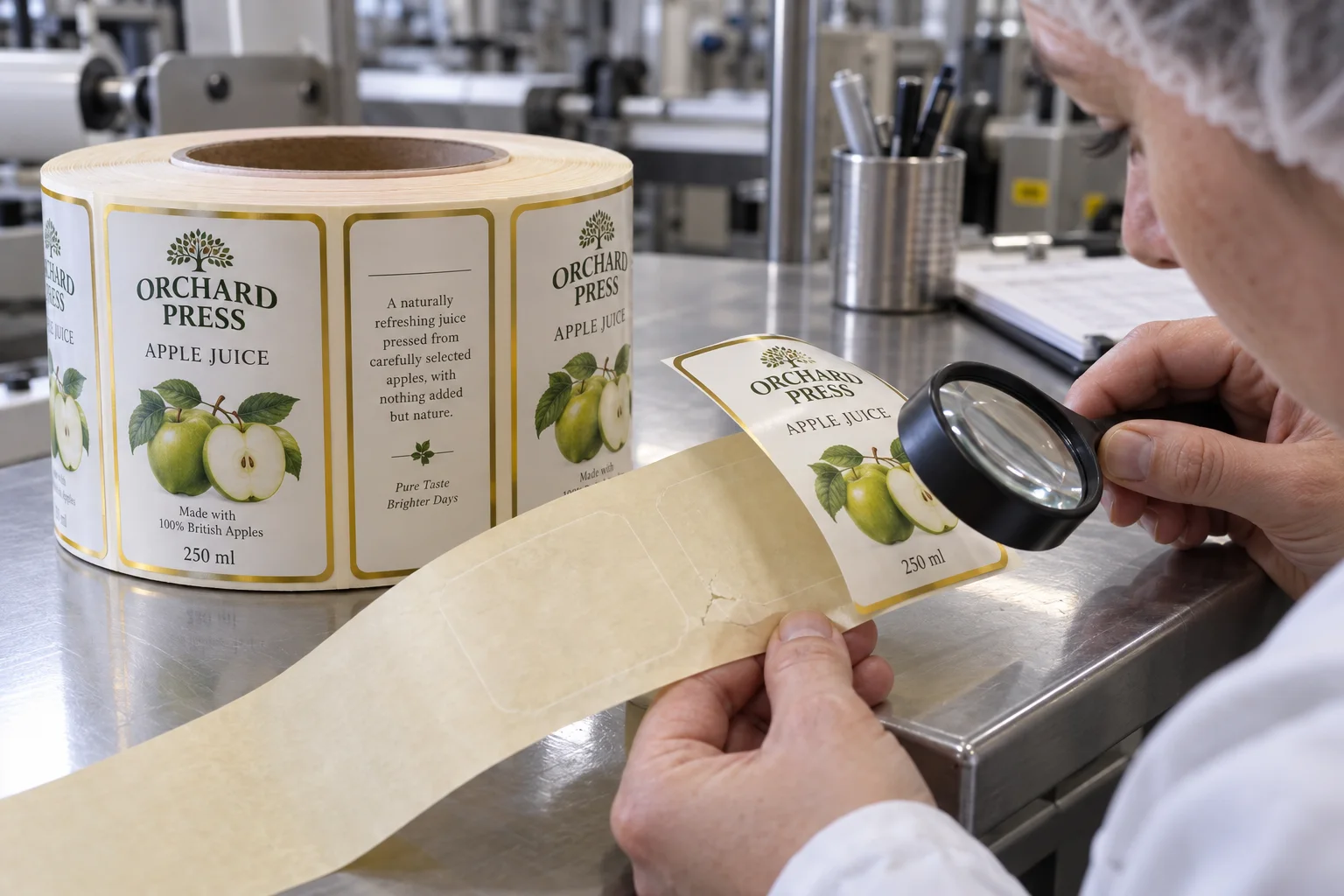
The artwork is fine. That does not mean the roll is fine.
If I am reviewing a complaint about web breaks, I want to see the backing before the buyer discards it. The attractive face of the label tells only half the story. The liner carries the labels through winding, transport and dispensing; damage hidden underneath can become visible only when the line places it under load.
The buying mistake is to specify paper or PET liner and stop there. Material selection matters, but it does not replace converting quality or a trial on the intended machine.
What kiss cutting is supposed to achieve
For ordinary pressure-sensitive roll labels, the die separates the label shape through the face material and adhesive while preserving a usable continuous release liner. Incomplete separation creates one set of problems; excessive cutting into the backing creates another.
Avery Dennison's converting guidance for a thin PET liner distinguishes a visible die impression from excessive deformation and recommends evaluation across the web and through the run. Its tooling and tension settings are specific to that construction, not universal numbers for every roll.
Two purchasing situations, two sensible thresholds
In a composite juice-brand example, an operator hand-peels labels for a short local launch. A lightly marked backing may never cause a practical interruption. The brand's immediate concern is clean label removal and a good appearance on the bottle.
A co-packer takes the same artwork into an automatic line. Now the liner must stay intact through the complete web path. A defect that was invisible to the founder can cause repeated stops. The co-packer is not being difficult by asking for more evidence; it is buying a different level of process reliability.
I would not resolve this disagreement by declaring every mark unacceptable. I would agree an inspection method and application trial before bulk supply. That protects the converter from arbitrary rejection based on appearance and the buyer from an attractive but unusable shipment.
Read the location of the break
| Pattern | Investigation priority | Sample to retain |
|---|---|---|
| Repeated break at a label corner | Die pattern and local liner damage | Several complete repeats |
| Break starts at the web edge | Edge nick, handling or slitting damage | Both edge and surrounding web |
| Failure at a splice | Splice construction and machine compatibility | The whole joint |
| Break changes with machine conditions | Web path and operating setup with the equipment supplier | Good and failed rolls with run notes |
These patterns prioritize inspection; they are not a diagnosis on their own. A damaged edge can coexist with an unsuitable machine setting. Changing several variables together makes it harder to know which correction worked.
How to raise a useful complaint
Stop and isolate equipment according to site procedures before retrieving a failed web. Keep the two sides of the break together, mark the direction of travel and record the roll number. Include neighboring labels so the converter can compare the failure to the die repeat.
Photograph the roll edge and core label as well as the close-up. Note whether the issue occurs at the start, middle or end of a roll and whether a previously accepted roll runs on the same setup. Do not cut away the defect just to make a neat sample.
I would ask the converter to inspect retained material from the same lot and review the actual stock-and-tool combination. If the label has changed from paper to film, or the liner thickness has changed, 'same artwork' does not establish that the old tooling remains appropriate.
Our buying view
A thicker liner is a proposal, not a diagnosis
My first instinct might be to offer a more robust liner because it gives the buyer a tangible change. I would hold that proposal until we understand the failure. More material may add cost without removing an edge nick or an over-aggressive die setup.
Conversely, a demanding applicator can justify a different liner even when the original roll was made correctly. The point is to demonstrate that choice on the line rather than sell it as a universal upgrade.
Write acceptance around performance
- Identify the complete face stock, adhesive and liner construction.
- Specify label shape, roll width, winding direction and roll dimensions.
- Agree samples from relevant lanes and parts of the production run.
- Define liner inspection and dispensing-trial methods with the suppliers.
- Document acceptable splices and how affected rolls will be identified.
For material selection, compare glassine and PET release liners. For failures at joins, use the finished-roll splice acceptance guide. A break investigation should preserve evidence before it turns into a debate about who caused the downtime.
Frequently asked questions
Is a visible die impression always a damaged liner?
No. Some constructions can show a controlled impression. The concern is structural damage or excessive deformation that compromises the liner. Ask the converter to assess it using the method appropriate to that construction.
Will switching to PET liner stop web breaks?
Not automatically. Tooling, die setup, edge damage, splices and machine conditions still matter. Trial the complete construction with tooling and equipment suited to it.
What sample should I keep after a web break?
Retain both sides of the break, neighboring labels and the roll identification. Record the location, line conditions and whether the break repeats at the same place in the die pattern.
Related buyer guides
Review your label specification
Send package photos, label dimensions, material details, quantity and application conditions. Include good and failed samples where possible so the discussion starts with evidence.
Continue with Missing Labels on a Roll: Printing, Matrix and Applicator Checks for a focused troubleshooting and purchase checklist.