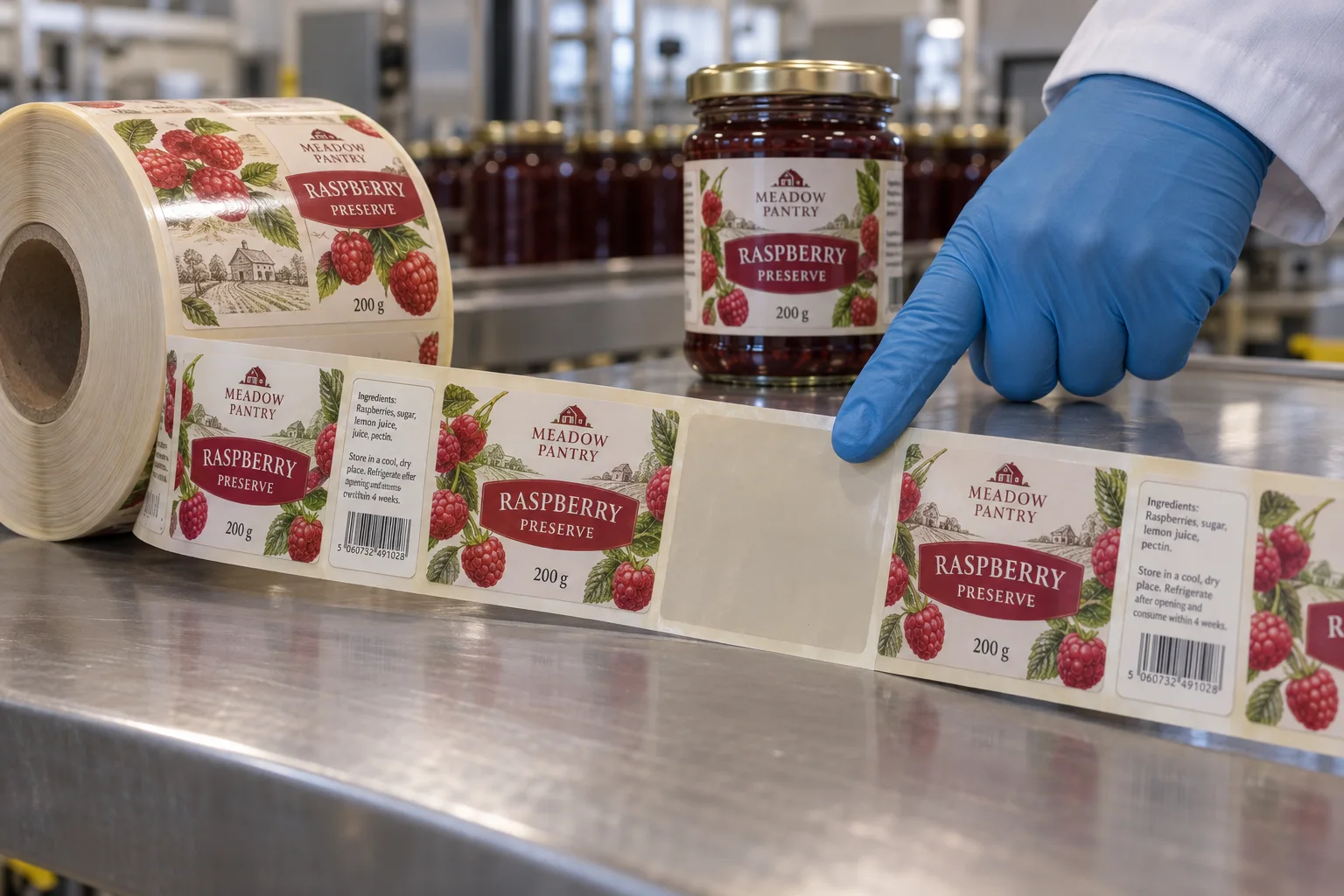
Find the first point where the label disappears
If a buyer shows me a blank patch of backing, I ask where that strip came from. Was it pulled from an unopened roll, collected after a printer, or found in the applicator waste path? The answer changes the supplier conversation immediately.
A missing label on an incoming roll is a converting and inspection question. A label that was present before the printer but absent afterward is a machine-path question. Both can be costly if bottles pass through unlabeled, but they need different evidence.
One jam jar, three possible histories
Imagine a composite preserve producer packaging jars with printed roll labels. The operator sees a single bare-liner gap. If the gap is visible before the machine, I would isolate the roll and ask the converter about inspection and matrix stripping. If the same label is stuck inside the printer, the incoming roll may be sound. If the gap occurs after a failed dispense, I would examine the applicator path and its reject logic.
Primera's printer guidance explicitly describes a missing label on the roll sometimes being stuck in the feed area. It applies to that printer family; it illustrates why a bare gap alone does not establish where the defect began.
Trace the web through the process
| Checkpoint | Question | Evidence |
|---|---|---|
| Unopened incoming roll | Is the gap already present? | Photo with neighboring repeat and roll ID |
| After any overprint step | Did a label stick in the printer? | Safe feed-path inspection and machine log |
| Peel and application point | Did the label dispense or transfer? | Consecutive web and bottle samples |
| Finished-pack inspection | Can unlabeled units be detected and rejected? | Documented inspection and reject check |
Stop and isolate equipment under its safety procedure before looking into a feed path. Never reach into a moving machine to recover a label for a photograph. Keep the strip before and after the gap so the converter can see whether the die pattern repeats or the edge of another label has lifted.
Matrix stripping deserves a specific check
During converting, waste matrix is removed around the finished labels. If a cut is incomplete or the construction is difficult to strip, a label can travel with the waste instead of staying on the liner. Avery Dennison's converting bulletin for a specific adhesive system notes this interaction. Its settings should not be treated as general rules for every food label.
I would ask the converter to review retained production material and inspection records from the affected lot. If the problem appears only after a later overprint step, the printer supplier should inspect the feed path and stock compatibility. Avoid changing adhesive and machine pressure at the same time.
Our buying view
Define the response to a gap before it ships
The cheapest label on paper may be expensive if a missing-label event reaches filled stock. I would agree how gaps are identified, what the supplier reports and what the packing line does when it sees one. The acceptable count is a contractual and process decision, not a universal number invented for an article.
Write a useful complaint or acceptance brief
- Record roll, carton and lot IDs and the location of the first gap.
- Keep the adjacent labels, matrix if available and printer or applicator logs.
- Describe how the line detects missing labels on finished packs.
- Agree allowable defects, splices and roll identification with the converter.
- Retest after any stock, tooling or machine-setting change.
For backing damage that leads to web breaks, read die-cut liner damage. For a different roll-quality issue at a join, use the roll splice guide.
Frequently asked questions
Are occasional missing labels acceptable?
That depends on the purchase specification and the applicator's ability to detect and reject them. Agree acceptance and communication rules before production.
Can a printer or applicator remove a label from a sound roll?
Yes. A label may stick inside the feed path or be pulled off during a fault. Compare the incoming web and machine-exit web to locate the first gap.
Does a bare gap prove a die-cut problem?
No. Matrix removal is one possibility, but the gap may also arise from handling, a feed jam or intentional inspection removal. Preserve the neighboring web and roll ID.
Related buyer guides
Review your label specification
Send package photos, label dimensions, material details, quantity and application conditions. Include good and failed samples where possible so the discussion starts with evidence.