A bottle line can use one roll at the front station and another at the back station. Writing one direction number on the purchase order does not necessarily identify either requirement. A number may also mean something different in two suppliers' charts.
Approve the leading artwork edge, printed side and actual station together, using an identified drawing and first-off reference. The register below closes that handoff; it is not a machine setup instruction.
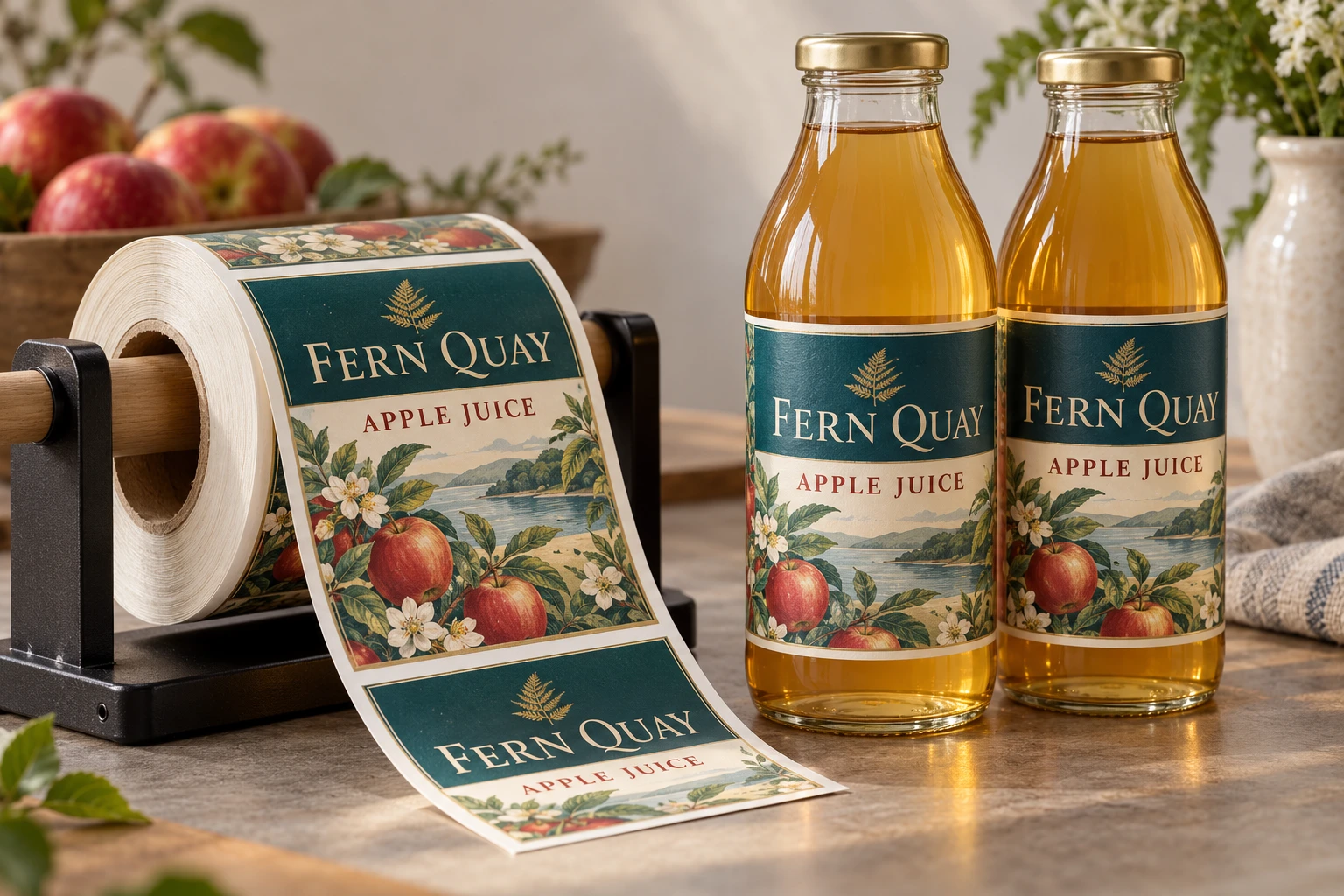
AI-generated packaging planning example. Fern Quay is a fictional brand. No actual customer job, equipment capability, compatibility test or measured result is depicted.
Make one direction record for each station
Keep the equipment owner's reference with the order. Show the artwork in a fixed, readable orientation and mark its leading edge. Separately show whether the print faces inside or outside the wound roll. A single arrow without a viewing direction can still be ambiguous.
| Station record | What to identify |
|---|---|
| Equipment and station | Line reference; front, back or other actual label position |
| Label identity | SKU, dieline, file revision and label role |
| Leading edge | Named top/bottom/left/right relative to readable artwork |
| Wound face | Printed side in or out, with the supplier's actual drawing |
| Shared roll pattern | Separate front/back rolls or an explicitly agreed alternating pattern |
| Acceptance reference | Approved drawing plus identified first-off or trial-roll evidence |
For a front/back set, do not assume that alternating labels on one roll can replace two separate station rolls. Ask the line owner which arrangement the equipment and production method require. If labels alternate, the sequence, spacing and repeat become part of the confirmed format rather than an incidental artwork choice.
Use chart numbers as references, not as the complete specification
If a supplier uses a numbered unwind chart, attach the version and highlight the selected illustration. Compare it with the named leading edge and print side in the order. If the picture and written instruction disagree, resolve the discrepancy before printing. Do not ask the converter to choose whichever interpretation seems more familiar.
When an artwork is rotated in a later file, revisit the leading-edge description. The label's top is a visual feature; a page's top in a design application may be only a file orientation. Record any change so the previous order's direction is not reused blindly.
Confirm the first-off without improvising machinery changes
The equipment owner should define any trial under the machine instructions and site procedures. Keep the sample roll identity linked to the approved artwork and construction. A photograph of a loose label confirms the design but not the way that design travels off its roll.
If delivered orientation appears wrong, isolate the affected rolls and preserve the order drawing and carton identification. Rewinding may be an option for the converter to assess, but it is not automatically a safe or complete correction. Do not infer that changing a machine path is acceptable merely because the label itself can be turned around by hand.
Use the roll-size acceptance sheet for the separate dimensional interface and the co-packer checklist for release responsibilities. The roll versus sheet workflow comparison applies if the format itself remains undecided.
Short answer
Label roll direction means the way printed labels face as they unwind from a roll. If labels are applied by machine, the direction must match the machine feed path. Confirm it before production so the labels do not arrive upside down, backwards or wound on the wrong side.
Roll direction terms buyers should know
| Term | Meaning | Why it matters |
|---|---|---|
| Top first | The top of the label comes off the roll first. | Common for machines that apply from a specific vertical orientation. |
| Bottom first | The bottom of the label comes off first. | Needed by some bottle or jar labelers depending on feed direction. |
| Left first | The left side of the artwork leads as it unwinds. | Often used for wrap labels or horizontal artwork layouts. |
| Right first | The right side of the artwork leads as it unwinds. | May be required when the machine feeds from the opposite side. |
| Outside winding | The printed label face is on the outside of the roll. | Visible artwork, common for many dispensers and labelers. |
| Inside winding | The printed label face is on the inside of the roll. | Required by some machines with a different unwind path. |
What happens if roll direction is wrong?
The label may still look correct in the artwork file, but the roll can fail during application. Operators may need to rewind the roll, change machine settings, slow down production or apply labels by hand. For a small test this is annoying. For bulk production it can delay packing and create waste.
Roll details to confirm before proof approval
| Field | Requirement to confirm |
|---|---|
| Orientation | Top first, bottom first, left first or right first. |
| Winding | Printed side outside or printed side inside. |
| Core size | The inner cardboard core diameter required by the dispenser or machine. |
| Gap and roll size | Space between labels and any maximum outside roll diameter. |
Hand application vs machine application
If your team applies labels by hand, roll direction is more forgiving, though neat packing still helps. If labels go into a dispenser, semi-automatic labeler or filling line, roll direction becomes part of the specification. The buyer should confirm it at the same time as label size, material and finish.
Label shape and container type also matter
Bottle labels, jar labels, cup labels and can wrap labels may use different artwork orientation. Tall narrow labels usually behave differently from wide wraparound labels. Front and back label sets may also need spacing that matches the machine sensor and application order.
How to send clear roll direction instructions
- Send a photo of the label roll currently used on your machine if you have one.
- Mark which edge should come off first using a simple arrow in the artwork proof.
- Tell the factory if the labels need outside winding or inside winding.
- Confirm core size and whether the machine has a maximum roll diameter.
- For front/back labels, explain whether they apply in one pass or separate passes.
Related guides
If you are still choosing format, start with roll labels vs sheet labels. For moisture, condensation or cold use, compare label materials and finishes before confirming roll setup.
Send the relevant project details
Send a station-specific roll inquiry with the equipment reference, readable artwork, highlighted unwind drawing, quantities and core/roll limits. Identify each front/back station separately and mark unresolved fields. The form opens an email draft; use listed email or WhatsApp for photos and files. Ask for confirmation of the proposed supply format before release.