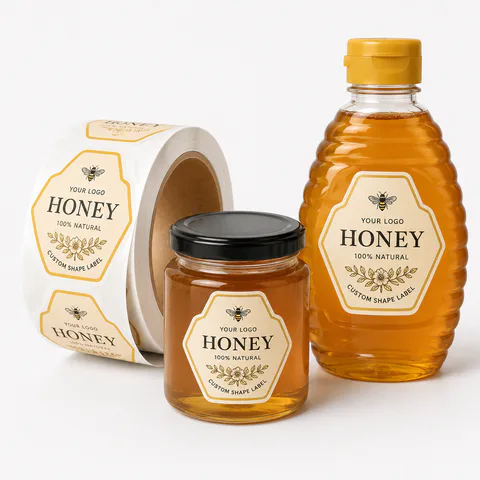
Short answer
Print product labels yourself when you are testing a few units, changing copy every week, or using simple black text labels that do not need premium shelf presentation. Order custom labels when the label must look retail-ready, match color consistently, survive moisture or oil, use a custom shape, or run smoothly on a packaging line.
Why Reddit keeps discussing this
Recent small-business and Etsy seller discussions show the same pattern: founders want flexibility, but they are also running into printer cost, ink cost, smudging, streaky color, waterproof paper limits, label paper compatibility and the learning curve of cutting consistent shapes at home.
That makes this a business decision, not just a printer decision. DIY gives control and speed for experiments. Factory labels give consistency, material choice, finishing, die-cutting and production-ready roll setup.
DIY printing vs factory custom labels
| Decision point | DIY label printing | Factory custom labels |
|---|---|---|
| Best use | Very small tests, temporary labels, black-only ingredient stickers, internal batch labels and frequent copy changes. | Retail packaging, repeated product runs, waterproof labels, custom shapes, roll labels and premium brand presentation. |
| Upfront cost | Printer, ink or toner, label sheets or rolls, possible cutter, test waste and time. | Proof setup, material selection and production quantity. MOQ starts from 100 pcs for many projects. |
| Color consistency | Depends on printer, media, driver settings and ink/toner condition. | Reviewed through artwork proof and production process; better for repeat orders and brand color control. |
| Water or oil exposure | Needs compatible waterproof media and sometimes laminate. Home testing may not match real storage conditions. | BOPP, PET, laminated paper and adhesive options can be matched to condensation, refrigeration, oil or handling. |
| Shape and finish | Limited by home cutter, sheet layout and manual trimming accuracy. | Round, oval, rectangle, custom die-cut, clear film, white film, matte, gloss, foil or textured options by project. |
| Application speed | Works for a few units but gets slow when orders grow. | Roll labels support hand application, dispensers, semi-auto labelers and production machines. |
Choose DIY printing when flexibility is worth more than finish
- You need fewer than 50 labels for a market test, photo shoot or sample handout.
- The product name, ingredients, flavor or warning copy changes constantly.
- The label is mostly black text and does not need photo-quality color.
- The package is dry, flat and not exposed to refrigeration, water, ice, oil or heavy handling.
- You are using the printout to test size and layout before ordering final labels.
Choose factory labels when the label is part of the product
For food, beverage, wine and personal care packaging, the label is often the first quality signal a buyer sees. Factory production becomes more sensible when the label must carry brand color, survive handling, wrap a curved surface, include small readable text, scan as a barcode, or match a future re-order.
Cost checklist before buying a label printer
Many founders compare only the price of blank labels against printed labels. That misses the real cost. Add printer cost, ink or toner, wasted sheets, failed media, trimming time, color troubleshooting, laminate, replacement parts and the value of your own production time.
A simple way to decide: estimate how many labels you need per month, how many designs change per month, whether the label must be waterproof, and how much time you can spend printing. If volume grows and design stabilizes, custom labels usually become the cleaner path.
What to send when you are ready for a custom label quote
- Packaging photos, including one straight-on image and one angled image.
- Exact label width and height, or the available label area on the package.
- Quantity for each design, such as 100 pcs, 500 pcs, 1,000 pcs or 10,000 pcs.
- Storage and use conditions: dry shelf, refrigerated, frozen, wet bottle, oily jar, bathroom use or outdoor handling.
- Application method: by hand, label dispenser, semi-auto labeler or production machine.
- Artwork file and any required barcode, QR code, ingredient panel, nutrition panel or warning text area.
For food brands, separate label printing from label compliance
A label factory can help reserve space and print the required information clearly, but the final wording should be confirmed by the responsible brand, manufacturer, importer or compliance professional. For U.S. packaged foods, FDA food labeling resources are the official starting point for identity, net quantity, ingredients, allergens and nutrition labeling questions.
When you are ready to compare buying options, the custom product label cost guide shows how to normalize printing, tooling, proof and freight into one usable figure.
FAQ
Can I use a home printer for waterproof product labels?
You can test waterproof printable media, but performance depends on the printer, ink or toner, label stock, dry time and laminate. For bottles, chilled drinks, sauces or oily products, request a production material recommendation before scaling.
Are thermal printers good for product labels?
Thermal printers are useful for black text, shipping labels, barcodes and simple operational labels. They are usually not the right choice for colorful retail product labels that need brand graphics, premium finish or long-term shelf presentation.
Can I order a small run before committing to bulk labels?
Yes. Many projects can start from 100 pcs. Use the first run to confirm size, material, color, barcode scanning and package fit before moving to larger quantities.