Short answer
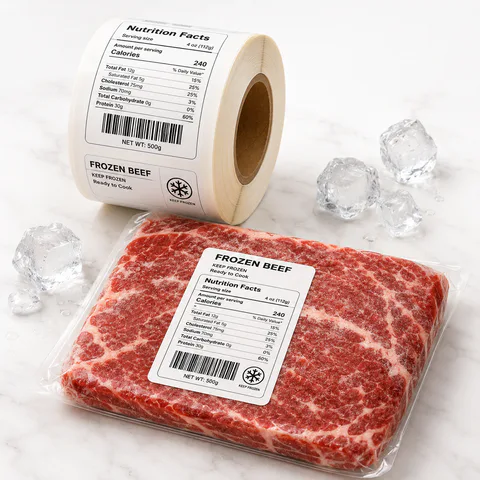
For frozen food vacuum bags, start with a moisture-resistant film label and an adhesive selected for the actual application temperature and bag surface. A label applied to a clean, dry bag before freezing faces a different challenge from one applied to an already-frozen, frosted package. Flexible bags also need a label size and construction that can move without lifting at the edges.
Four conditions that control label performance
| Condition | Question to answer | Why it matters |
|---|---|---|
| Application temperature | Is the bag room temperature, chilled or already frozen? | Adhesive wet-out is harder on very cold surfaces. |
| Surface moisture | Is there condensation, frost or water on the bag? | Moisture can block contact between adhesive and package. |
| Bag flexibility | Will the package bend, shrink or form around the food? | Large stiff labels may bridge folds and lift. |
| Storage and handling | Will labels rub in cartons, freezers or delivery boxes? | Print protection and scuff resistance may be needed. |
Apply before freezing when the process allows
Applying labels to clean, dry packaging at a suitable temperature usually gives the adhesive a better opportunity to build contact before cold storage. If operationally possible, label the sealed bag before it becomes frosted. Keep oil, food residue and condensation away from the application area.
If labels must be applied after freezing, tell the printer. The adhesive needs to be evaluated for cold application, not merely cold storage. These are different requirements and should not be treated as interchangeable.
Film labels vs paper labels on freezer bags
BOPP or PET film is often considered for moisture, tearing and flexible packaging. Paper may still suit a dry outer carton or a package that never encounters frost, but an unprotected paper face is generally less forgiving around moisture and abrasion. Material choice should be based on the real package environment rather than the desired visual style alone.
For a broader comparison, read paper vs film labels for food packaging and the refrigerated food label material guide.
Size and shape for flexible vacuum bags
- Keep the label away from heavy gussets, deep wrinkles and heat-seal edges.
- Avoid making the label so large that it bridges uneven food shapes.
- Use rounded corners to reduce snagging during carton packing.
- Place barcodes on the flattest repeatable panel.
- Reserve a consistent area for date and lot coding before artwork approval.
A vacuum bag changes shape after air is removed. Test the label on the bag in its final packed state, not only on an empty flat pouch.
Protect print and barcode readability
Condensation, abrasion and freezer handling can affect printed information. A suitable protective finish may help with scuffing and moisture, while clear layout and contrast support barcode scanning. Do not place a barcode across folds, seams or a highly curved food surface. Scan printed test labels after packing and again after the expected cold-storage cycle.
Frozen food label proof checklist
- Confirm product name, net quantity and all required information with the responsible compliance party for the destination market.
- Reserve an ingredients, allergen, nutrition and storage-information area where applicable.
- Mark the variable date or lot code zone.
- Check barcode size, contrast and flatness on the final packed bag.
- Approve the label dimensions on a physical package.
- Test adhesion before, during and after freezing.
What to send for a frozen-bag label quote
- Bag material, finish and dimensions.
- Photos of the empty bag and final vacuum-packed product.
- Temperature and moisture conditions at label application.
- Storage temperature range and expected handling.
- Label size, quantity per SKU and application method.
- Artwork plus date-code and barcode requirements.
Factory viewpoint
Our view: application temperature is the overlooked specification
Many frozen food label requests begin with “freezer-safe material,” but that phrase is incomplete. A label that remains attached in frozen storage may still fail when it is first applied to a frosted or very cold vacuum bag. Cold-service performance and cold-application performance are separate requirements.
Our recommendation is to design the packing sequence so labels are applied to a clean, dry bag before freezing whenever possible. Then test the finished package through sealing, freezing, carton friction and thawing. That process test is more useful than approving a material name in isolation.
Frequently asked questions
Can labels be applied to already-frozen vacuum bags?
They can, but frost, condensation and low surface temperature make adhesion more demanding. Tell the label supplier the package is already frozen so cold-application requirements can be reviewed.
What label material is best for frozen food bags?
Moisture-resistant BOPP or PET film is often considered, but the final choice depends on the bag surface, application temperature, flexibility and storage conditions. Physical testing is still necessary.
Where should a barcode go on a frozen vacuum bag?
Place it on the flattest repeatable area, away from seals, deep folds and irregular food shapes. Scan a printed test after the product is packed and frozen.
Related label guides
Prepare a production-ready label quote
Send the package photo, label size, quantity, storage conditions, application method and artwork status. We can review the material direction and proof requirements before bulk production.