Short answer
For refrigerated or frozen food packaging, start by reviewing moisture-resistant film labels such as white BOPP, clear BOPP or PET. Paper can still work for some dry applications, but condensation, oil, freezing and curved packaging can change the material choice.
Cold storage label material comparison
| Packaging condition | Material direction | What to check |
|---|---|---|
| Refrigerated deli packs | White BOPP, clear BOPP or laminated paper depending on moisture exposure. | Condensation, package curve, label size and whether the label touches cold plastic. |
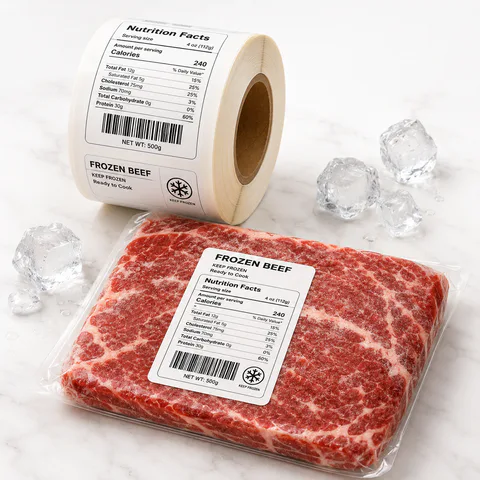
| Frozen meat trays | Moisture-resistant film with adhesive reviewed for cold storage. | Freezer conditions, barcode readability, nutrition panel area and application timing. |
| Sauce jars and oily foods | Film or laminated options with oil and handling review. | Oil exposure, jar curve, lid label needs and wipe resistance expectations. |
| Bakery chilled items | Paper, textured paper or film depending on brand look and storage. | Moisture, grease, kraft box surface and short-term vs long-term refrigeration. |
| Clear containers | Clear film or white film depending on readability and design. | Background contrast, small text, barcode area and 鈥渘o label look鈥?expectations. |
Why refrigerated labels fail
Cold packaging creates practical problems: moisture can form on the container, frozen surfaces can reduce adhesion, oil can affect the face material, and curved or flexible packaging can stress the label edge. These issues are easier to prevent before proof approval than after bulk production.
Food buyers should confirm these details
- Packaging surface: plastic tray, glass jar, pouch, paper box, film pack or container lid.
- Storage: dry shelf, refrigerated, frozen, wet handling or changing temperature.
- Application: hand-applied, roll dispenser, semi-auto machine or labeling line.
- Label function: branding, barcode, nutrition panel, date code, seal strip or tamper label.
- Finish: matte, gloss, writable area, textured paper or waterproof film.
Film labels vs paper labels for cold food
Film labels usually handle moisture better and are often preferred for frozen food, refrigerated meat, drinks, sauce jars and condensation-prone packages. Paper labels can look warmer and more natural, especially for bakery or premium food, but they should be matched carefully when refrigeration or grease is involved.
Proof review should include the real package
A digital proof is not only about artwork position. For refrigerated food labels, the proof stage should confirm size, corner radius, barcode area, material direction, finish, roll or sheet format and whether the design remains readable on the package surface.
What to send for a fast food label quote
FAQ
Do frozen food labels need waterproof material?
Often yes, but the exact material depends on the packaging surface, freezing conditions and application timing. Moisture-resistant film is commonly reviewed for frozen food labels.
Can refrigerated food labels include barcode and nutrition panels?
Yes. Send the required text, barcode size and nutrition panel layout so the label size and print readability can be checked before production.
Can the same label work for fresh and frozen packaging?
Sometimes, but it should be reviewed. A label that works on a dry fresh pack may not perform the same after freezing, condensation or oil exposure.
Cold storage after application is not the same as cold application. See minimum application vs service temperature.
Continue with Chilled Meat Tray Labels: Keep the Heat-Seal Rim Clear for a focused purchase checklist.
Continue with Frozen Seafood Carton Labels: Keep Cases Scannable in the Cold for a focused purchase checklist.