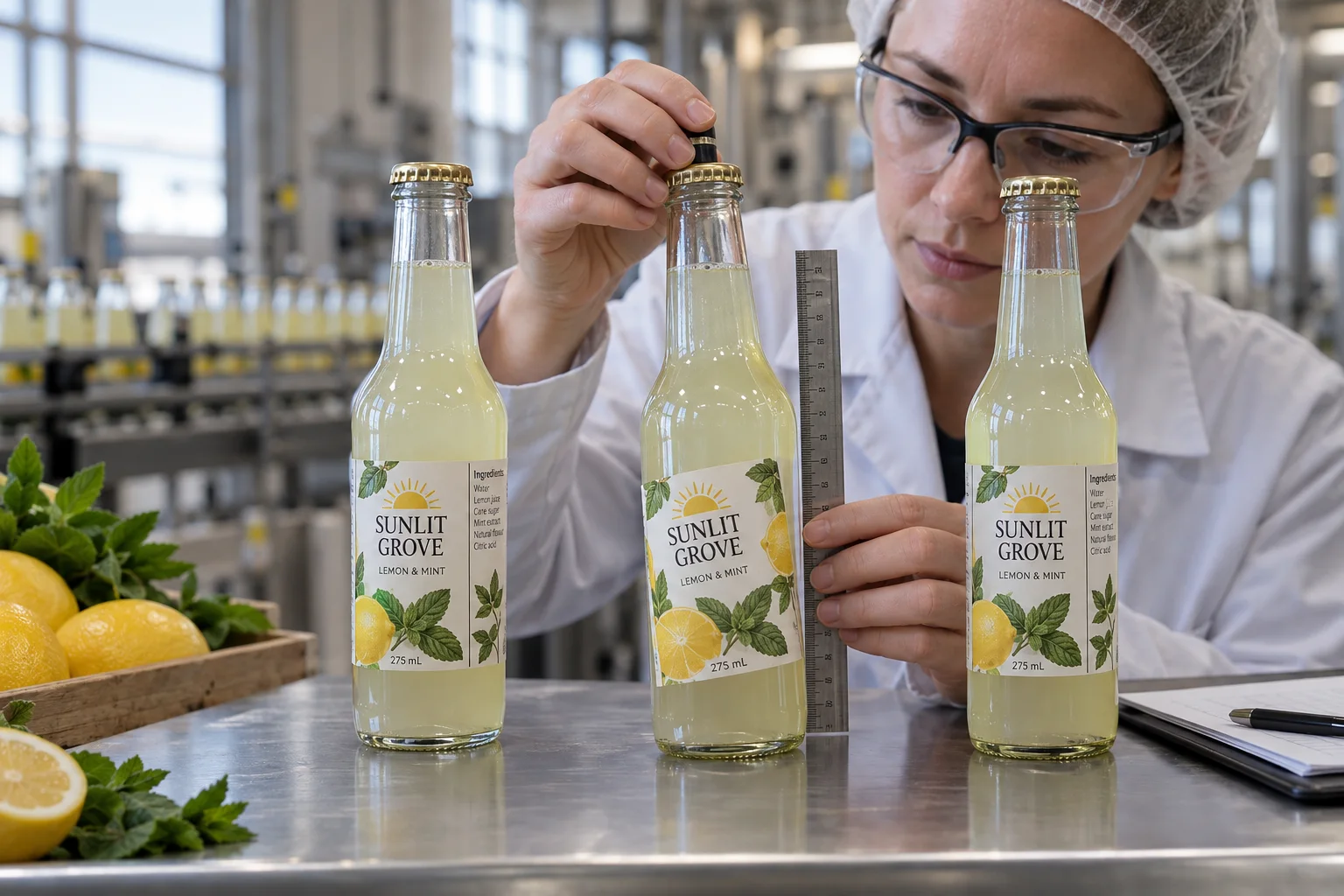
Which line on the bottle is 'level'?
Buyers often email a close-up of a crooked front panel and ask the printer to correct it. I want the entire bottle in the photograph. Does the label tilt relative to the bottle base, the fill line, the cap, a molded seam or the graphic border? Those are not always the same reference.
For a straight-sided bottle, a stable base and agreed front-panel height may be practical. On a tapered or irregular container, a rectangular label may appear crooked even when its placement is repeatable. Before a new print order, we should decide whether the issue is geometry, print registration or application.
A small launch and a running bottling line
In a composite lemonade launch, staff apply labels by hand. A simple paper placement guide and shorter artwork solve most visual inconsistency. Buying an automatic applicator immediately would be an expensive answer to a small-volume problem.
Another buyer already has an applicator. One in every several bottles arrives visibly tilted while retained flat labels are consistent. I would keep a consecutive sequence of bottles, not just the worst one, and ask the equipment team to check container presentation, guides and timing. The fix may be in bottle control, not label material.
Quadrel's automatic-labeling troubleshooting guide explains how product sensing, spacing and timing can affect application position. That guidance helps focus a machine inspection; it is not permission to adjust moving equipment without the operator's procedure.
Separate three kinds of 'crooked'
| What looks wrong | First comparison | Likely owner of next check |
|---|---|---|
| Printed border tilts within the cut shape | Unapplied labels from several roll positions | Artwork and converting teams |
| Whole label tilts on some bottles | Consecutive bottles and line video | Application and container-handling teams |
| Every label appears tilted on a tapered bottle | Paper fit sample on the actual filled package | Packaging and label design teams |
For line checks, the Lancing bottle-labeller guide also points to bottle stability, guide alignment and application-head setup. Make changes under the equipment maker's safety instructions and document the settings before and after.
Agree an acceptance sample, not a vague promise
I would mark the intended label position on an approved bottle sample, identify the reference edge and show how height and rotation will be judged. Then I would agree sampling during a normal run. A tolerance needs to be achievable and visually appropriate for the package; there is no honest universal millimeter number for every bottle and machine.
The sample set should include beginning, middle and end of run, plus different bottle lots if the package supplier varies. If the bottle itself is inconsistent, a printer cannot solve every visual deviation by recentering the artwork. Conversely, if the flat label print shifts relative to the die cut, no amount of conveyor adjustment will make the design internally straight.
Our buying view
Pay attention to the cheapest useful experiment
My first impulse could be to offer a new die or stronger adhesive. Neither is justified by a tilted photograph. I would compare unapplied labels with a short sequence of filled bottles and an approved reference bottle. That small comparison can prevent a full reprint and give the line team a clear target.
Send these items before requesting a fix
- Photos of full bottles from front, side and base.
- A consecutive good-to-bad sample sequence and retained flat labels.
- Container drawings or known mold and lot variation.
- Agreed reference edge, intended height and visual acceptance sample.
- Applicator model, setup notes and operating conditions.
If the symptom is a fold rather than rotation, use our bubbles and wrinkles guide. For difficult shoulders, see labels for tapered bottles.
Frequently asked questions
Can a printer fix crooked labels by changing the artwork?
Only if the printed design or die alignment is the source. If good labels become crooked on the line, investigate bottle handling and application setup first.
Is there a standard millimeter tolerance for every bottle?
No. Set placement acceptance against the actual bottle, artwork, customer expectations and line capability. Document the reference and sampling method.
Why do only some bottles have skewed labels?
Intermittent skew can reflect variable bottle positioning, conveyor spacing, surface condition or application timing. Preserve a sequence of samples to identify the pattern.
Related buyer guides
Review your label specification
Send package photos, label dimensions, material details, quantity and application conditions. Include good and failed samples where possible so the discussion starts with evidence.