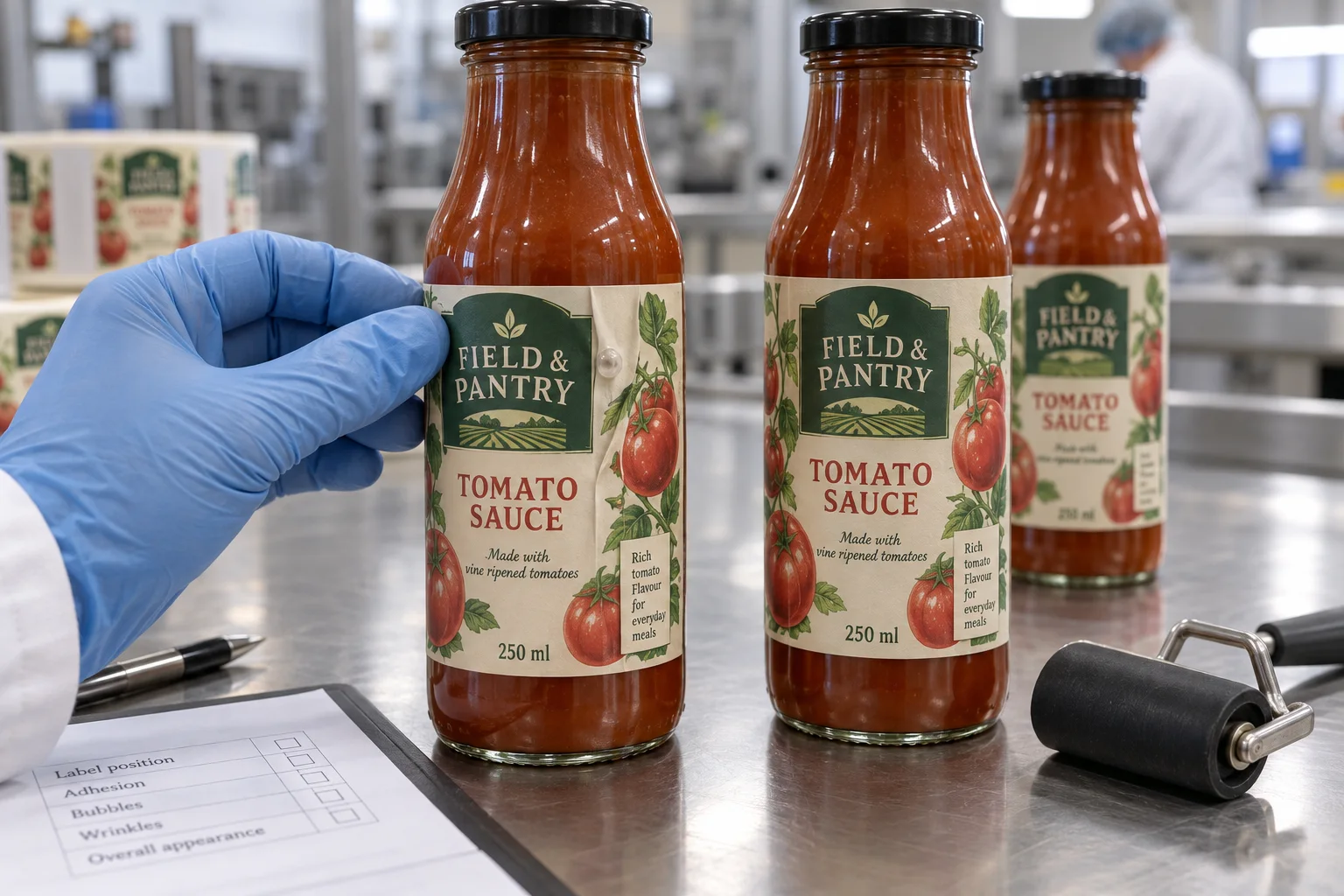
Start with the defect, not the replacement material
My first question would be: was the bottle already wrong as it left the applicator, or did it look good until the next shift? That answer is more useful than a close-up photograph with no time attached.
Avery lists application, surface condition and container fit among the possible causes of bubbling labels. That is a useful warning against blaming adhesive alone. A dry, clean comparison bottle is a starting point, not proof that every production bottle has the same surface.
Two buyers can show the same wrinkle and need different fixes
Consider a composite sauce-brand example. The founder labels a small batch by hand. A wide rectangular label reaches into the curved shoulder. The first few look acceptable; later bottles crease near the top corner. The tempting purchase is a thicker, more expensive label. I would first try a shorter label that stays on the straight wall, using a paper fit sample before commissioning another printed run.
Now consider a co-packer using a straight-sided bottle. Hand-applied samples look smooth, but the line produces a fold at the trailing edge. Here I would involve the equipment technician and compare package handling and application setup. Redesigning the artwork would be a costly distraction if the existing label already fits.
Both buyers want the same thing: to avoid relabeling filled stock. The founder can afford a little extra hand work. The co-packer needs repeatable output at the agreed operating speed. Their acceptable solutions should not be identical.
Build a small evidence table
| Observation | Check next | Do not assume |
|---|---|---|
| Bubble appears immediately | Surface, initial contact and wipe-down sequence | All bubbles mean weak adhesive |
| Fold repeats at one corner | Label fit, taper and application alignment | More pressure will flatten any shape |
| Only line samples fail | Setup and package control with the machine supplier | A more costly film is automatically required |
| Defect appears after storage | Timing, moisture, package change and construction | A photo proves the mechanism |
A comparison that a small brand can actually run
Keep the artwork, bottle batch and label batch fixed. Label a clearly identified group under normal production conditions and another small group on clean, dry packages using a controlled hand-application method. Use only cleaning methods approved for that container and packaging process. Do not introduce an unapproved solvent near food or machinery.
Photograph each group immediately and at agreed checkpoints after filling, cooling and storage. Note the first visible defect rather than just the final appearance. This is a screening exercise, not a universal laboratory standard. If the hand-applied controls also fail, that redirects the discussion toward fit, surface or construction.
For machinery, isolate equipment and follow the manufacturer's procedures before any adjustment or inspection. Do not press a moving bottle by hand to imitate a video demonstration. Ask the supplier to evaluate the actual machine and application sequence.
Delayed bubbles deserve a separate conversation
Avery Dennison's air-egress material overview distinguishes trapped air during application from outgassing in relevant applications. It describes a specialized adhesive construction; it does not establish that your glass sauce bottle is outgassing or that every bottle needs that material.
I would send the converter a sequence of photos, an unused label strip, an affected bottle and a retained good bottle. A single damaged sample encourages everyone to defend their part of the process. Matched samples give the packaging supplier and printer something they can compare.
Our buying view
Pay for the fix that survives production
The easy mistake in a quotation review is to offer upgraded film before asking for the bottle. I would reverse that order. A smaller label or corrected setup may solve the problem without increasing every future order's cost.
But I would not insist on a cheap material after it has failed a fair trial. If the package and process genuinely need a different construction, the rework cost matters more than the saving per thousand labels.
What to put in the next inquiry
- Package material, shape and photographs of the complete bottle.
- Label dimensions and where the defect starts.
- Whether the bottle is filled, warm, chilled or dry at application.
- Label and bottle batch references, application method and machine model.
- Good and failed samples with the time and storage history recorded.
Use our label size planner for an initial cylindrical-package estimate, then check the physical package. For a consistent top-edge fold, continue with labels for tapered bottles. If the main defect is lifting rather than trapped air, read why bottle labels peel off.
Frequently asked questions
Why do bottle labels bubble immediately?
Possible causes include trapped air during application, surface contamination, container irregularities or an unsuitable label fit. Compare clean dry bottles applied by hand with bottles from the line before changing materials.
Will stronger adhesive remove wrinkles?
Not necessarily. Stronger initial tack can make a badly positioned label harder to correct. Package geometry and application settings may need attention before adhesive selection.
Can a label look good now and bubble later?
Yes. Record changes after filling, cooling, handling and storage. Moisture, package movement or outgassing in some constructions can require different investigations; the appearance alone does not identify the cause.
Related buyer guides
Review your label specification
Send package photos, label dimensions, material details, quantity and application conditions. Include good and failed samples where possible so the discussion starts with evidence.
Continue with Crooked Bottle Labels: Placement Tolerances and Line Checks for a focused troubleshooting and purchase checklist.