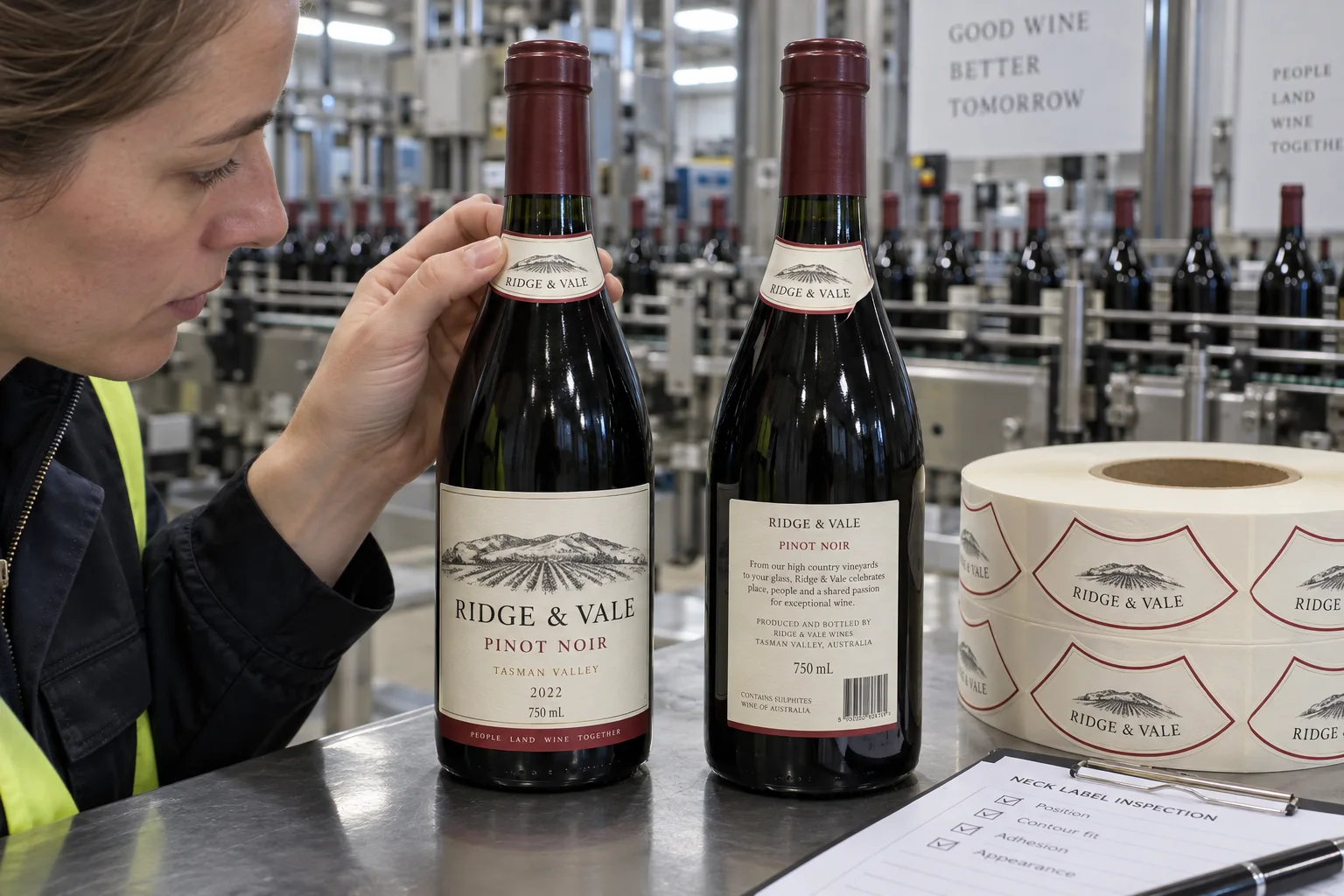
The neck is its own package surface
A winery may approve a beautiful front and back label set, then add a narrow neck band late in the project. I understand the temptation: the band makes the bottle feel finished without redesigning the main panel. But the neck's diameter and angle differ from the body, and the capsule leaves less usable height than a flat artwork screen suggests.
Quadrel advises adapting labels to tapered neck geometry, including a narrower top where the circumference changes. UPM also identifies thin films for beverage neck labeling. Neither source removes the need to test the actual bottle and line.
Two buyers, different meanings of premium
Imagine a composite winery preparing a short club release. Staff apply labels by hand, and a small curved paper template fits neatly below the capsule. The brand values a tactile paper look and accepts some careful manual placement. I would ask it to test the actual printed stock after chilling, then order a modest run.
A larger private-label buyer has the same artwork but a contract bottler applying thousands of bottles. The bottler needs a neck-label station with repeatable orientation relative to the front panel. A hand-applied sample may be beautiful but irrelevant to the machine. I would ask for the labeler's format limits and a trial before approving the die and roll layout.
Measure three relationships, not only width
| Relationship | What to agree | Typical failure if ignored |
|---|---|---|
| Neck taper to label shape | Top and bottom circumference at the panel | Wrinkle, skew or edge lift |
| Neck label to capsule | Clearance from closure and tamper features | Unwanted overlap or distorted edge |
| Neck label to front panel | Rotational and vertical alignment reference | Two good labels that look mismatched |
The label must not interfere with a closure or any required tamper feature. Regulatory copy placement also varies by market; have the wine producer's compliance reviewer approve required information rather than treating this geometry guide as legal advice.
Sample with the cap, bottle and final finish
Use the exact glass bottle and capsule, not only a drawing. Make an unprinted paper shape to confirm usable area, then apply a production-like printed sample. Photograph front, side and back. If the neck band is meant to align with the body art, check several bottles, not just one carefully positioned hero sample.
Ask the bottler how the package is held and oriented. HERMA notes that curved or tapered bottle surfaces and multi-panel alignment complicate machine labeling. Confirm whether the existing line can apply an additional neck label or whether a separate station or manual step is involved.
For an ice-bucket wine, retain bottles after realistic wet handling and inspect neck corners. The same paper and adhesive can behave differently on a short tight curve than on the wide straight body. Do not assume the front-label trial qualifies the neck band.
Our buying view
Sometimes the better neck label is no neck label
We could sell an extra printed component. I would first ask what job it does: vintage cue, limited edition, gift presentation or required data. If the main label already carries the message and the bottler lacks a reliable station, adding a neck band may create cost and rejects without helping the buyer. When it has a clear purpose, I would budget a physical fit and line trial rather than squeezing it into the front-label proof.
Neck-label request checklist
- Actual glass and capsule samples, plus neck measurements.
- Intended front-panel alignment and usable vertical area.
- Material, finish and expected wet or chilled handling.
- Bottler station capability, unwind and orientation details.
- Approved paper template and production-like printed sample.
For the body panel in wet use, review wine label materials for ice buckets. For a bottle whose entire body tapers, see tapered bottle labels.
Frequently asked questions
Can I print a rectangular label for a tapered wine neck?
Sometimes a short rectangular panel works, but changing circumference can cause a longer panel to wrinkle or appear slanted. Make a paper fit sample first.
Should neck labels be applied with the main label?
That depends on the bottling line and labeler. Confirm station capability, roll direction and orientation with the equipment owner before ordering.
Do neck labels need separate wet-use testing?
If the bottle is chilled or placed in an ice bucket, test the complete neck-label construction and its edge adhesion as well as the main label.
Related buyer guides
Review your label specification
Send package photos, label dimensions, material details, quantity and application conditions. Include good and failed samples where possible so the discussion starts with evidence.
Continue with Labels for Embossed Glass Wine Bottles: Find the Flat Panel First for a focused purchase checklist.