A short order combines several herb labels on one sheet. It uses the sheet efficiently, but the operator has to search among similar designs for every jar. A partly used sheet returns to the bench, and the remaining labels no longer make the intended picking order obvious.
Choose sheet layout around the manual application job. Decide whether one SKU per sheet, separated blocks or a mixed arrangement provides the best balance of quantity, waste and picking control. Material efficiency is one part of the purchase; the work required to apply the labels is another.
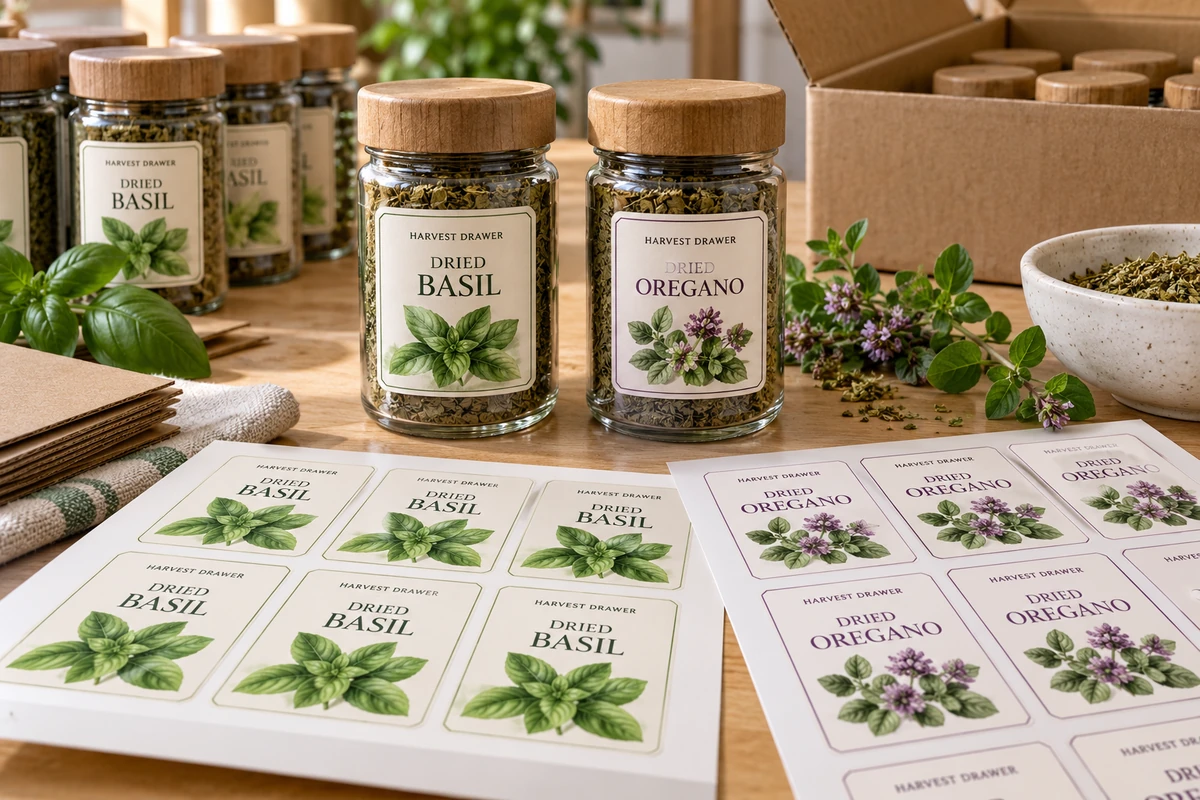
Start with how the bench consumes labels
Ask whether the packer completes one SKU at a time, alternates products or prepares kits containing several components. Identify the number of operators and how sheets move between them. The same layout can be convenient for a gift set and confusing for a single-flavor packing run.
Record label components separately. A front label and a small back label may belong to the same jar but have different quantities, positions and picking risks. Do not combine them under one sheet total without showing how complete sets are formed.
The roll-or-sheet guide compares supply formats. Once sheets are selected, imposition becomes a practical ordering decision rather than a purely graphic arrangement.
Compare the available layouts
One SKU per sheet keeps identity simple and can make partial-sheet returns easier to control. It may create unused positions or a different production minimum depending on the supplier's process. Ask for an actual quotation rather than assume the extra separation has a fixed cost.
Mixed sheets can suit kits or very small coordinated quantities, but they need a clear relationship between the sheet and the packing task. A layout that contains equal quantities of each flavor may be unsuitable when the order needs unequal amounts.
Separated SKU blocks provide another option. Their usefulness depends on how the sheet is handled and whether individual blocks can be identified after separation. Do not recommend cutting sheets apart without checking the supplier's and packer's supported handling method.
Prepare a sheet-layout brief
| Input | What to tell the printer |
|---|---|
| SKU and component | Exact identity and artwork revision |
| Quantity | Required usable pieces for each design |
| Work sequence | One SKU, alternating SKUs or complete-kit assembly |
| Sheet constraints | Supported size, handling and any equipment requirements |
| Layout preference | Separate sheets, separated blocks or a proposed mix |
| Identity | How sheet and partial-sheet contents remain recognizable |
| Approval sample | Final-size layout with all relevant designs |
| Residual stock | How unused pieces are counted and returned |
The brief defines the manual workflow. The supplier must still confirm printable area, cutting, material and available production arrangements.
Check the longest and most similar designs
A family of herb labels may differ only by one word and a small illustration. Ask a person unfamiliar with the design to pick the requested SKU from the proposed final-size sheet. The exercise is a practical review, not a measured error-rate claim.
Include the designs that are most easily confused and the smallest components. A generous mockup of the largest front label can conceal the difficulty of finding a tiny back label on the same sheet.
The multi-SKU artwork guide controls file identity. The sheet review should preserve that identity through the physical arrangement and the packer's normal sequence.
Reconcile quantities at sheet level and piece level
Ask how the quoted quantity translates into complete sheets and whether any designs will be over- or undersupplied by the proposed layout. If the layout creates excess of one SKU, make that visible before approval.
Use a clearly labeled arithmetic example where helpful. A hypothetical sheet containing four basil labels and two oregano labels creates a two-to-one ratio. Ordering ten such sheets supplies forty and twenty pieces before any agreed setup or inspection use. It does not meet an unrelated requirement for equal quantities simply because the total is sixty.
The SKU quantity reconciliation guide helps connect physical pieces to complete packs. Keep any label-set ratio explicit so the sheet total does not become an ambiguous unit.
Plan for partly used sheets
Decide where unused sheets and partial sheets go, how their identity remains visible and which stock can return to unrestricted use. A remaining label may look correct while its artwork revision or exposure history is unknown.
Avoid a layout that depends on text printed only in a discarded margin if the packer routinely separates the sheet. Conversely, do not add intrusive production information to the consumer label when a supported sheet carrier or job traveler would serve the control need.
If sheets are intended for an in-house printer as well as manual application, obtain the equipment's media and feeding instructions. Do not assume that a partly stripped sheet can safely be fed again merely because unused labels remain. Follow the applicable printer and media guidance.
Compare the complete work rather than the prettiest nesting
Ask the packer to review separation, picking, placement and leftover handling. A compact mixed layout may reduce sheet material while increasing searching or inventory complexity. A separated layout may be easier to use but create more surplus for a slow SKU.
Record those tradeoffs without inventing productivity percentages. If the decision needs measured labor data, run a defined observation with the actual task and state its limits. A demonstration on an empty desk does not establish production speed.
Approve one identifiable arrangement
Keep the final sheet drawing, artwork revisions, piece counts and supported handling method with the order. Reopen the layout when quantities or designs change; the earlier arrangement may no longer fit the new ratio.
Request a multi-SKU sheet proposal with quantities by design, final label dimensions, the manual packing sequence and how partial sheets will be stored. The form opens an email draft; review it and attach your SKU schedule through email or the listed WhatsApp route.