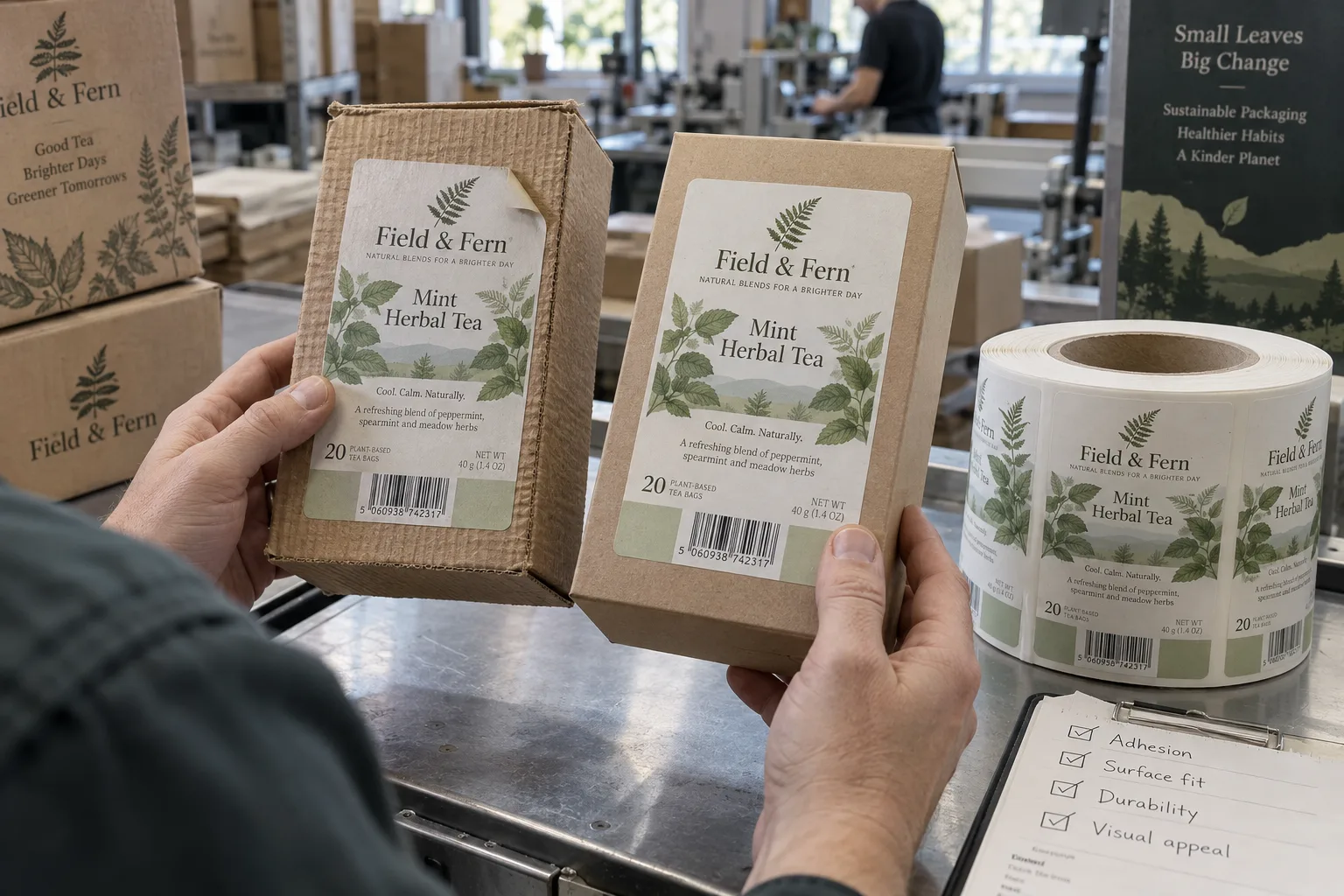
Recycled board is not one surface
A carton can be called recycled and still have very different surface texture, coating and dust from another recycled carton. If a label corner peels off after packing, I would ask for the carton lot before changing the adhesive. A smooth area beside a fold can behave differently from the rough wall next to it.
Avery Dennison lists hotmelt options for rough surfaces and recycled corrugated board. That establishes a possible trial direction, not that every recycled food carton needs the same adhesive. Product-grade suitability and food-packaging documentation must be checked for the actual application.
Two buying situations that look similar on a complaint photo
Imagine a composite small tea brand switching from a white coated carton to a rough brown board. Its old label lifts at one top corner. If the brand can move the graphic a little away from a deep fold, I would try that first with the same artwork size. The buyer may preserve the shelf look without paying for a more aggressive construction.
A larger snack packer may not have that freedom. Its label position is set by a machine and a display-window layout. Here the useful comparison is among approved face and adhesive constructions on actual board lots, at real speed. A hand-pressed sample that holds for an hour is too narrow an approval.
Map the carton before testing materials
Mark folds, glue seams, dusty cut edges and flat panels. Apply test labels to the area where the production label will go. Try cartons as they arrive on the line, not only specially wiped or hand-selected ones. Keep an approved control carton and note differences in board lot and storage. If the carton itself changes supplier, repeat the fit check before assuming the label remains valid.
| Symptom | First check | Possible purchasing response |
|---|---|---|
| Lift beside a fold | Panel geometry and pressure | Move or reshape the label |
| Lift on the whole rough face | Board texture and adhesive trial | Compare suitable constructions |
| Only one carton batch fails | Board lot and surface condition | Review carton supply as well as labels |
| Print looks dull but adhesion holds | Face stock and artwork proof | Separate visual from adhesive decisions |
Test appearance and bond separately
The brown carton may visually warm the brand, but it can also reduce contrast through a translucent or thin label. A more opaque face can solve the artwork problem without solving adhesion, while a high-tack adhesive can hold a label whose colors still look wrong. Approve the printed look and the bond as two separate outcomes on filled cartons.
Ask the label supplier for the intended face, adhesive and liner, and document any applicable packaging-contact requirements. Do not infer compostability or recyclability of the full labeled carton from the words recycled paperboard alone.
Our buying view
Pay for the carton you actually buy
I can quote an expensive high-tack roll quickly. I would first compare the carton surface and label position. If the customer later changes board lots or adds a coating, that extra adhesive may have bought confidence in the wrong sample. A controlled carton trial is a cheaper argument to have before production.
A useful RFQ for the converter
- Physical cartons from current and expected board lots.
- Exact label panel and folding or gluing sequence.
- Label artwork, finish, dimensions and quantity per SKU.
- Hand or machine application and storage conditions.
- Acceptance time points after packing and transit simulation.
If the look of the label itself is the question, our kraft paper label guide compares finish and exposure. For a broader material screen, use paper versus film food labels.
Frequently asked questions
Why do labels lift on recycled cartons?
Surface roughness, dust, coating and limited actual contact can all contribute. A failed corner alone does not identify the cause.
Is hotmelt adhesive always required?
No. Some hotmelt options are designed for rough recycled board, but suitability depends on the exact board, application and storage conditions.
What should be included in a trial?
Use cartons from the real board supply, the intended label finish and the actual application method; inspect after packing and expected handling.
Related buyer guides
Review your label specification
Send package photos, label dimensions, material details, quantity and application conditions. Include good and failed samples where possible so the discussion starts with evidence.