An ornate honey-label outline looks convincing in the mockup. It has fine points, narrow bridges and a decorative cutout. The drawing is approved for appearance before anyone asks how the surrounding waste will be removed from the liner during converting.
Review the shape with the converter before committing to tooling. Keep the desired visual effect, the cut geometry and the proposed waste-removal route in the same decision. A shape that can be drawn is not automatically a shape the chosen construction can be produced and supplied reliably.
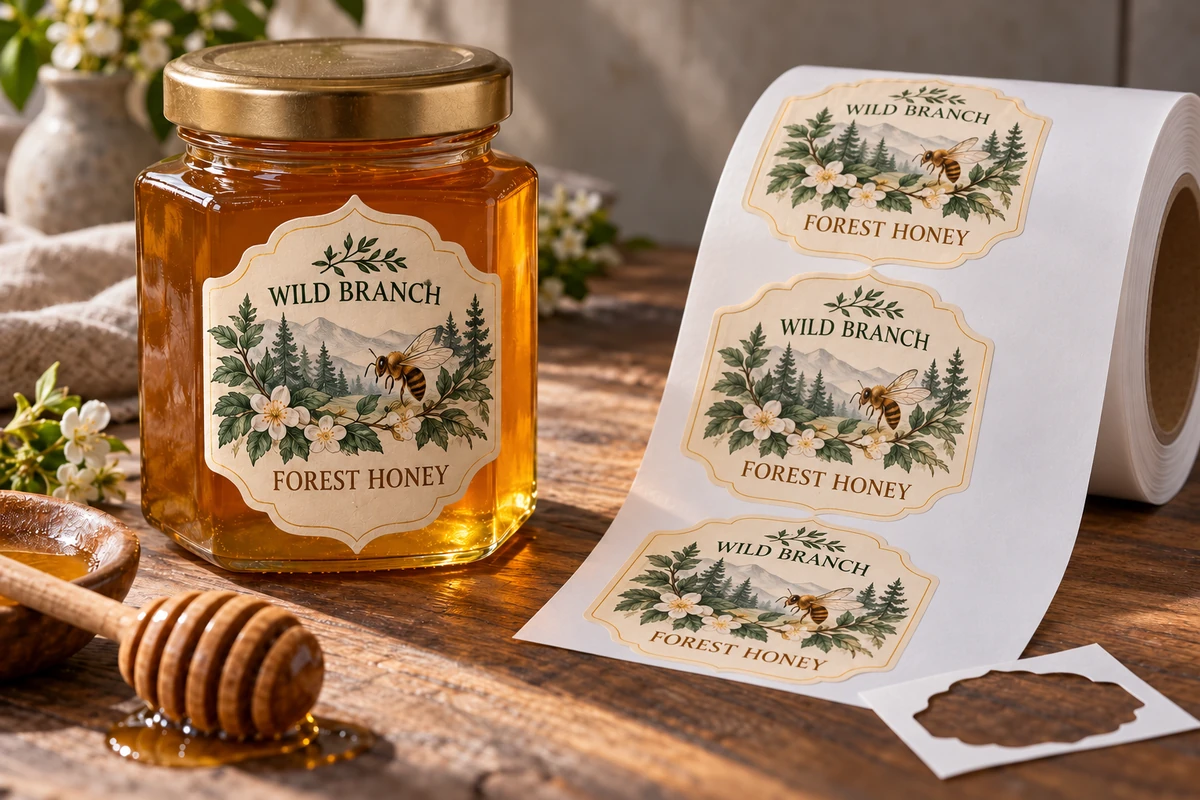
Show the actual cut geometry
Provide a dimensioned cut outline separate from the printed border. Identify internal cutouts, narrow sections, sharp changes of direction and any area where the artwork approaches the edge. Let the converter distinguish a print-registration question from a physical cutting question.
The custom die-cut guide explains the difference between cut path and brand border. Matrix review adds another layer: what material remains around and between the labels, and how the converting operation removes it.
Specify the proposed material construction and finished format. A successful shape on one face material or adhesive does not establish the same converting result on another. Ask which sample or prior evidence the converter considers relevant to the offered construction.
Ask the converter to identify the constraint
The surrounding waste, often called the matrix, has to be handled through the converting process. Ask which features of the drawing and construction could limit the proposed arrangement. Request a marked drawing or specific explanation rather than a vague statement that the shape is difficult.
An Avery Dennison bulletin for particular aggressive adhesives gives an example of construction-specific converting restrictions. Do not apply those restrictions to all food-label stocks; use them as a reminder to obtain advice for the actual selected material.
The buyer should not dictate press adjustments or removal speeds from an online article. The purchasing decision is whether the converter has reviewed the geometry and can support the quoted deliverable under an agreed approval route.
Use a shape-release review sheet
| Review area | Question to resolve |
|---|---|
| Cut drawing | Is the physical boundary dimensioned and revision controlled? |
| Fine features | Which points, bridges or cutouts need modification or trial? |
| Construction | Does the reviewed face/adhesive/liner match the quote? |
| Waste arrangement | How are the surrounding matrix and internal waste handled? |
| Delivered format | What gaps, edge waste or retained features will remain? |
| Application | Can the accepted label dispense and fit the actual package? |
| Evidence | Drawing review, representative cut sample and relevant observations |
| Release | Accepted geometry, exclusions and changes still required |
Keep the converter's response with the tool order. This sheet is an editorial decision aid, not a test method or a guarantee that a particular feature can be manufactured.
Compare a simpler shape with the original design
Ask for a marked alternative that preserves the brand's main visual purpose. A rounded point, a wider connection or a simplified internal detail may be worth considering, but the converter must explain the actual proposal. Do not assume every ornate outline needs to become a rectangle.
A hypothetical honey brand might retain a distinctive crest at the top while simplifying a very narrow decorative tail. Another design may keep the original outline through a different approved construction or supply arrangement. Compare the appearance, price, tooling and application consequences of the real options.
Make the designer review the changed physical boundary with the artwork. A small geometry adjustment can affect the printed border or available text area. The technical improvement should not silently cut through an approved brand element.
Keep cutting quality and liner condition separate
A label can separate from the matrix while the liner is still unsuitable for the intended line. The liner-break investigation guide addresses a related but distinct question. Do not accept visible waste removal as proof of the whole web's integrity.
Where relevant, obtain a representative web sample rather than only a detached label. Identify the tooling, construction and finishing route it represents. If the sample was hand cut or produced by a different method, record that limitation before approving production tooling.
Ask which observations are needed at the converter and which belong on the application line. The two stages should have connected records but should not be collapsed into one undefined passed sample.
Check the shape on the package
After manufacturability review, assess placement and handling on the actual container. Narrow projections and tight curves may create an application question separate from whether the converter can cut them. The small-diameter label guide addresses tight-radius fit and edge observations.
Use the intended filled-pack condition where it affects the panel or handling. Keep the agreed label position and any clearance from closures or opening features visible in the trial record.
Do not invent a universal corner radius or minimum bridge width. Those values should come from the selected construction, tooling and process review. A number without that context can create false confidence or rule out a workable design unnecessarily.
Order the shape that was actually approved
Tie the quote, die drawing and artwork to the same revision. Ask how later construction changes will trigger another review. If the converter proposes a geometry adjustment after tooling starts, obtain the relevant design approval instead of letting a production workaround become an undocumented final shape.
Send an intricate-shape review brief with the cut drawing, intended construction, container photo and the visual features you need to preserve. Ask for specific constraints and supported alternatives. The form opens an email draft; review it and attach the drawing through email or the listed WhatsApp route.