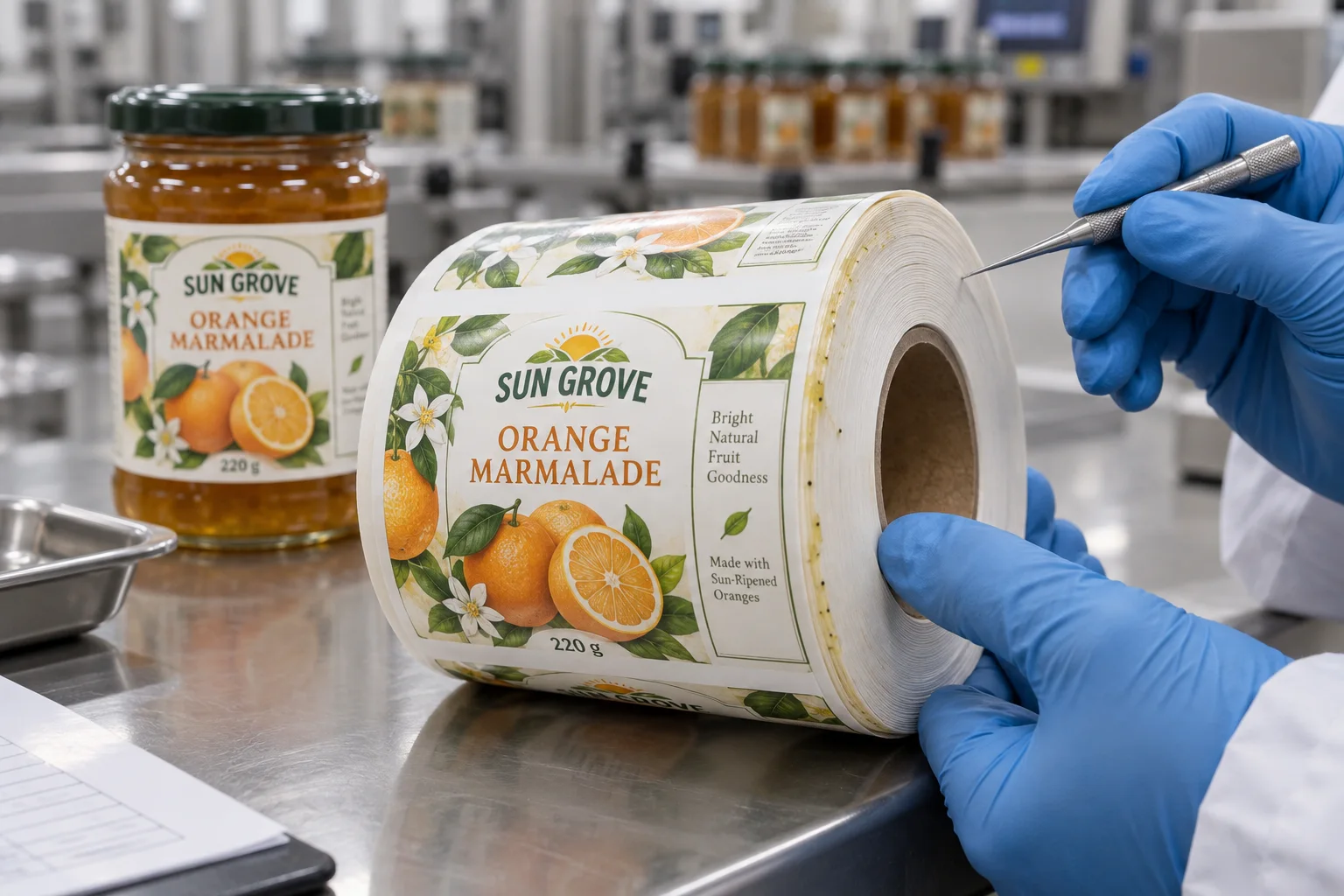
Inspect the roll before the residue reaches the machine
A sticky roll edge is easy to dismiss because the printed face still looks good. I would treat it as a reason to pause and inspect, particularly when the roll is intended for automatic application. The useful question is not whether a finger feels tack. It is whether adhesive is where it should not be, and whether that affects handling or dispensing.
Keep unopened rolls from the same delivery available for comparison. Once every roll has been handled, unwrapped and moved around the production floor, it becomes harder to establish when the change began.
Two buyers should not automatically buy the same adhesive
Take a composite marmalade producer using smooth, dry glass jars. After a previous lifting problem, the buyer asks for the strongest adhesive available. That request sounds decisive, but it leaves the actual application conditions undefined. I would first check why the previous bond failed and whether the new construction solves that problem without introducing another.
Contrast that with a packer labeling a difficult plastic surface. A more demanding adhesive construction may be justified after testing. Replacing it with a lower-tack option purely to simplify converting could move the failure from the label roll to the finished bottle.
The first buyer needs a proportionate specification. The second may need specialized converting and handling. In both cases the decision should follow the application, not a ranking from 'weak' to 'strongest'.
What the technical guidance actually tells us
Avery Dennison's AJ059 product data sheet warns that its high coat weight and high tack require care because of ooze risk. That particular product is for durable-goods applications; it is evidence that construction affects converting requirements, not a recommendation to use it on food jars.
The company's CleanFlake HDPE technical guide also discusses the interaction of die cutting and finished-roll tension with adhesive halo or transfer. Its advice belongs to the stated product system. Ask your converter for guidance for the stock actually on your purchase order.
Separate four things before naming a cause
| What to inspect | Record | Who can help |
|---|---|---|
| Tacky roll side | Which side, extent and affected roll numbers | Converter quality team |
| Halo around individual labels | Position relative to die-cut shape | Converter and material supplier |
| Transfer to neighboring layers | Unwind behavior and sample location | Converter |
| Residue only after line use | Start point and operating conditions | Equipment supplier and converter |
Also record transport and storage history. Exposure outside a product's recommended conditions deserves investigation, but it should not become an automatic excuse for a production defect. A sealed retained roll and delivery photos are useful to both sides.
Contain the problem without contaminating the evidence
Identify affected rolls and keep them separate from accepted stock. Photograph the edge before wiping it. Retain the packaging, lot details and a sample showing the label-to-liner boundary. Ask whether a controlled unwind inspection or line trial is appropriate.
Do not dust rolls with powder or wipe them with a convenient solvent. That can change the adhesive, introduce contamination and obscure the original problem. Any machine cleanup should follow the equipment manufacturer's instructions with the machine safely isolated.
If production cannot wait, ask for a documented decision about which rolls can be used and under what conditions. 'Run slowly and see' is not a complete acceptance plan. Name the inspection points, stop conditions and person authorized to release the material.
Our buying view
Strong glue is not a substitute for a complete specification
In a quotation review, I would be wary of promising that more tack fixes everything. It is an easy answer to sell and a difficult promise to defend when the original problem was moisture or package shape.
I would be equally wary of removing adhesive performance the package genuinely needs. A balanced construction should bond on the package and convert into rolls that can be handled reliably.
What to change on the next order
- Name the actual package surface and application conditions.
- Record the approved material construction, not only 'permanent adhesive'.
- Agree inspection of roll edges, label edges and unwind behavior.
- Obtain product-specific packing, storage and shelf-life guidance.
- Run an appropriate trial if the material, tooling or roll format changes.
Use our roll storage and shelf-life guide for handling questions. For adhesive selection, read acrylic versus rubber-based adhesives. The goal is a stable process from delivery to the finished pack, not an impressive adhesive description on its own.
Frequently asked questions
What is label adhesive ooze?
It is adhesive extending beyond its intended edge or boundary. On finished rolls it may appear as tacky edges, an adhesive halo or transfer. The converter should identify the mechanism rather than relying on a photograph alone.
Does high-tack adhesive always ooze?
No. Risk depends on the particular construction and process. Some high-coat-weight, high-tack products require special converting care, but high tack is not proof that a supplied roll is defective.
Can I clean sticky roll edges with solvent?
Do not treat production rolls with an unapproved solvent or powder. Quarantine affected rolls and ask the converter and equipment supplier for a documented disposition and any approved cleaning procedure.
Related buyer guides
Review your label specification
Send package photos, label dimensions, material details, quantity and application conditions. Include good and failed samples where possible so the discussion starts with evidence.