Why this topic keeps coming up
Public small-business and food founder discussions often circle around the same problems: how to make a nutrition facts panel, who is responsible for label accuracy, whether a home-printed sticker is good enough, and how to order a small batch without paying for packaging that may change after the first retail test.
For a packaging buyer, the useful answer is practical: separate the regulatory content from the physical label specification. A label factory can help with size, material, finish, roll direction, proofing and print quality. Your brand, co-packer or compliance advisor should confirm the final required wording for your market.
Food label checklist before printing
| Buyer question | What to confirm | Why it affects printing |
|---|---|---|
| What package are you labeling? | Jar, bottle, pouch, tray, bakery box, deli container or frozen food pack. | Package shape controls label curve, adhesive choice, die-cut shape and whether roll labels or sheet labels are more practical. |
| How large should the label be? | Width, height, corner radius and available flat area on the package. | A label that is too wide for a curved jar can wrinkle, lift at the edge or cover mandatory information. |
| Does it need a nutrition facts panel? | Panel size, orientation and whether the product qualifies for any small-business exemption in the target market. | Nutrition text needs clear print area and readable contrast. It should not be squeezed after artwork is approved. |
| Where do ingredients and allergens go? | Ingredient list, allergen statement and any language requirements for the destination market. | Small labels can run out of space quickly. This may require a back label, wraparound label or larger label shape. |
| How will the food be stored? | Room temperature, refrigerated, frozen, oily surface, wet handling or condensation. | Storage decides whether paper is enough or whether BOPP, PET or another film should be reviewed. |
| How will labels be applied? | Hand application, dispenser, semi-auto labeler or full labeling machine. | Roll direction, gap, core size and outside/inside winding must match the application method. |
Material options for common food packaging
| Food packaging type | Common label direction | Best use case |
|---|---|---|
| Bakery boxes and paper bags | Coated paper or textured paper | Dry packaging, kraft boxes, pastry seals and premium hand-made positioning. |
| Sauce jars and condiment bottles | White BOPP or laminated paper | Oil-resistant review, curved surfaces and retail shelf handling. |
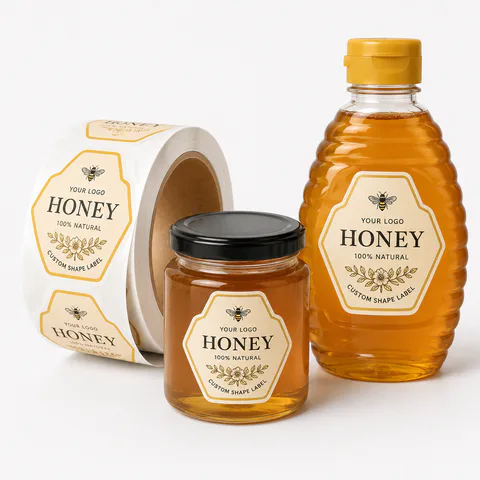
| Honey and jam jars | Paper, white BOPP or clear film | Front labels, lid labels, tamper seals and warm natural branding. |
| Frozen food packs | White BOPP, PET or freezer-suitable film | Cold storage, moisture, barcode readability and freezer handling. |
| Clear deli containers | Clear BOPP, white BOPP or removable option by project | Ready-to-eat packaging where visibility and label readability both matter. |
What a small food brand should send for a quote
- One straight photo and one angled photo of the package.
- Label width and height in mm or inches.
- Order quantity, such as 100 pcs, 500 pcs, 1,000 pcs or 10,000 pcs.
- Storage condition: shelf, refrigerated, frozen, wet handling or oily food contact risk.
- Artwork file if available, preferably AI, PDF, SVG, EPS or high-resolution PNG.
- Need for front label, back label, lid label, seal strip, barcode area or QR code.
- Preferred finish: matte, gloss, clear film, white film, textured paper, foil or custom die-cut.
Compliance notes to check before final artwork
For U.S. packaged foods, FDA food labeling guidance is the correct official starting point. FDA also publishes a small business nutrition labeling exemption guide. That does not remove other required label information such as statement of identity, net quantity, ingredient statement and business name/address where applicable.
Major food allergens also need careful review. FDA guidance lists milk, egg, fish, Crustacean shellfish, tree nuts, wheat, peanuts, soybeans and sesame as major food allergens for FDA-regulated foods. Your label artwork should leave enough room for the required declaration format in your market.
Recommended label setup for a first retail test
If your product is still being tested, do not lock yourself into a huge label run. Start with a small batch, confirm package fit, storage performance and barcode scanning, then scale the exact approved size and material.
FAQ
Can I print food labels at home first?
You can use a home print test to check rough size and layout, but it does not prove waterproof performance, freezer performance, barcode scan quality or production color matching. For retail use, request a material proof before scaling.
Should I choose paper or BOPP for food labels?
Choose paper for dry, premium or kraft-style packaging. Choose BOPP or PET film when the package may face moisture, refrigeration, freezing, oil or frequent handling.
Can the factory create the nutrition facts panel?
A label factory can reserve space and print the panel clearly. The actual nutrition values and required wording should be confirmed by the brand, producer or compliance professional for the destination market.