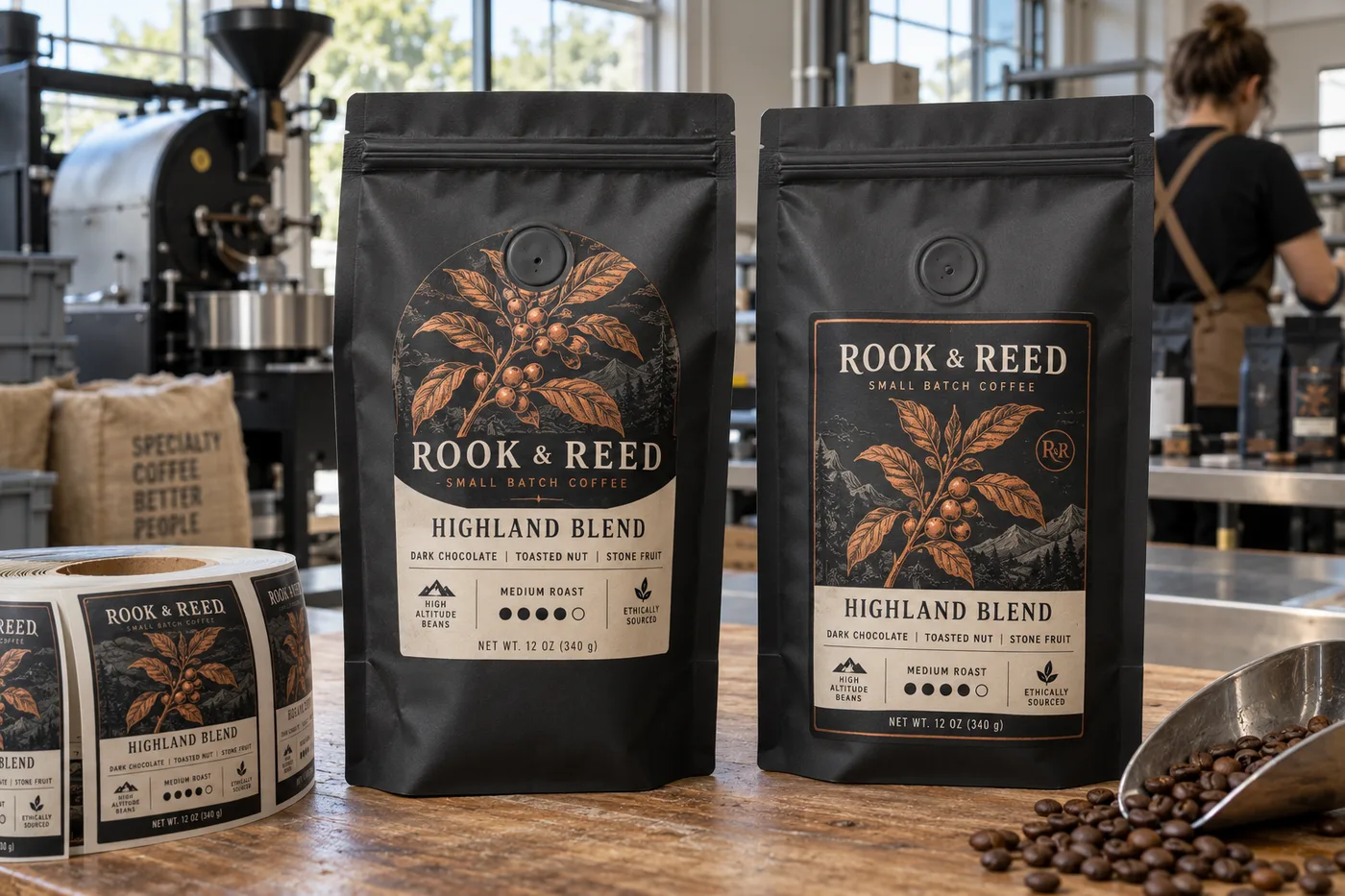
The valve owns part of the front panel
A roaster may hand us a handsome front label and a flat bag drawing. I still want a filled bag. The one-way valve is a functional part of many roasted-coffee packages, and its position competes with the label, fold and zipper. Coffee packaging manufacturer MTPak discusses valve placement near the bag headspace. That is useful context, but the bag supplier must confirm the actual valve position and construction.
The image here is a fictional packaging illustration, not a record of a customer trial. The question it raises is real: where does the printed label sit after the bag is filled and handled?
Two roasters, different acceptable compromises
Imagine a composite neighborhood roaster selling a single origin in short runs. Its valve sits high on the bag, leaving an uninterrupted rectangle below. I would keep the label modest and let the bag color carry the rest of the identity. That avoids paying for a taller label merely to wrap around a feature it cannot cover.
A second composite roaster uses the same bag for several blends and needs more room for tasting notes. Here I would ask whether the bag supplier offers a consistent alternate valve position. If not, a back label for changing details may be cheaper and easier to manage than crowding the front. Neither route should be chosen from a screen mockup alone.
Mark the no-label areas on the real bag
Fill samples to normal weight, close the zipper and heat seal as production will, then mark the valve, top seal, zipper, gusset fold and any display window. Measure the smallest flat usable area across several bags. Check how the front bows when full. A stiff paper face that looks crisp on a board can show more edge lift on that curve than a compatible film construction; trial the actual face and adhesive before specifying either.
| Observation | First response | What to approve |
|---|---|---|
| Artwork reaches valve | Shorten or reposition the label | Unobstructed valve on filled bags |
| Label touches zipper fold | Move lower or divide information | Usable closure after handling |
| Lower edge creases at gusset | Raise or narrow the label | Flat presentation when standing |
| Variable roast information changes often | Use a stable front and smaller variable back label | Correct SKU and batch workflow |
Test the application sequence
Ask whether labels are applied to empty or filled bags and by hand or machine. That choice changes the surface presented to the applicator. Keep a few production-like samples through filling, sealing, boxing and normal shelf handling. Inspect the valve area and label edges at each stage. A single freshly pressed sample is not enough to approve the roll.
Our buying view
Protect the functional feature first
I would rather reduce the front label slightly than sell a larger one that fights the valve. If the brand needs the extra copy, move it to a coordinated back label or review the bag specification with its supplier. The roll should fit the package the roaster actually ships.
Send this coffee-label brief
- Filled bags from the intended bag lot, with valve and zipper positions marked.
- Front and back artwork plus required variable fields.
- Application stage, method and expected packing speed.
- Bag surface, storage conditions and likely handling.
- Approval photos of standing, filled bags and a retained roll strip.
For a broader format choice, read our coffee packaging label guide. If the bag itself is the main constraint, compare the stand-up pouch placement checklist.
Frequently asked questions
Can a label cover a coffee degassing valve?
Keep the valve unobstructed. Confirm its location on the actual bag lot, then approve label placement on a filled sample.
Is a smaller label always necessary?
No. Moving the valve or changing the front-panel layout may preserve more artwork space, subject to the bag supplier and packing process.
What should a roaster send for a quote?
Send filled bags, the valve and zipper positions, artwork size, storage conditions, application method and expected order quantity.
Related buyer guides
Review your label specification
Send package photos, label dimensions, material details, quantity and application conditions. Include good and failed samples where possible so the discussion starts with evidence.