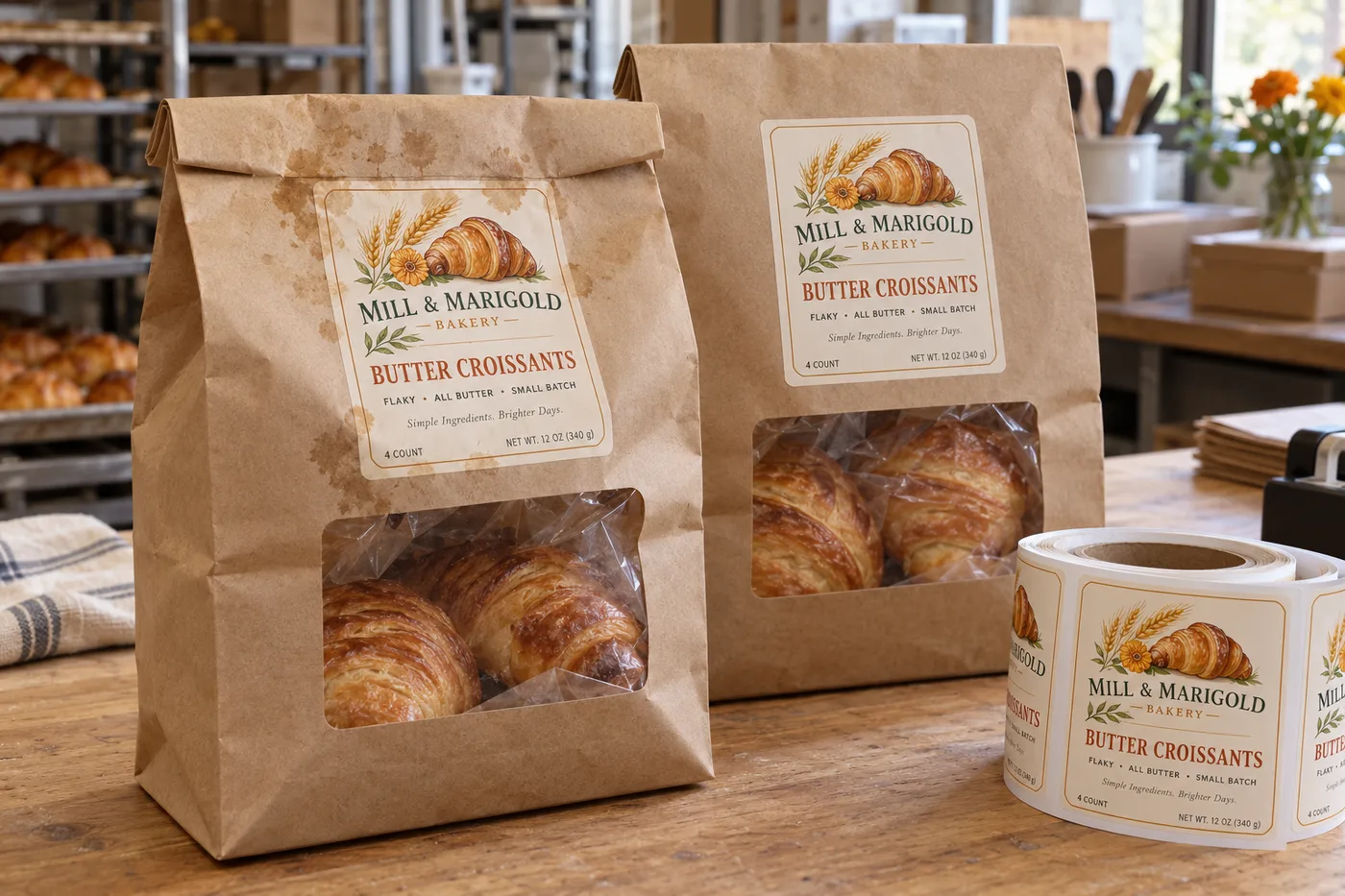
The paper bag is not one uniform surface
A bakery may want a charming textured label to match its brown bag. I would first ask where the pastry sits, how the bag closes and which panel receives the sticker. The clean outer face near the top can behave differently from a folded area close to butter or oil. An empty bag trial tells only part of the story.
Avery Dennison describes grease-resistant label constructions as an option for oily applications. That is a possible material direction, not a promise that every printed bakery label is greaseproof or suitable for direct food contact. Approve the exact construction and documentation.
Two bakeries, two practical decisions
Imagine a composite bakery selling dry cookies in folded paper bags. Its sticker mostly acts as a closure and brand mark. I would test the folded thickness and how easily staff can apply it during the rush. An expensive barrier film may add little if grease never reaches the label.
A second composite bakery packs warm butter pastries with a clear window. Here the bag may receive grease marks during normal handling. I would move the label to a cleaner panel if possible, then compare a suitable printed film or protected paper construction. A beautiful uncoated paper face that stains before the customer gets home is not a premium outcome.
Separate the bag, adhesive and print questions
Try a few filled bags using normal product temperature and closure method. Mark where oil appears after expected holding time. Apply samples to clean and realistic-use bags, then inspect adhesion and print appearance separately. Do not use a wiped sample to approve a process that never wipes bags. If the label touches a food-contact area, ask the bag and label suppliers to review the applicable construction and regulatory documentation together.
| Symptom | First comparison | Buyer decision |
|---|---|---|
| Edge lifts at a fold | Placement and fold thickness | Move or resize the label |
| Face shows oil stain | Printed face and protective finish | Trial suitable barrier options |
| Ink rubs during handling | Print process and finish | Change protective construction |
| Bag itself becomes greasy | Food wrap and bag choice | Review package before label cost |
Approve the completed retail pack
Run the sample through the bakery's real packing sequence, carry bag and display time. Photograph it at packing and after normal holding. Record whether failure is a peel, stain or artwork readability problem. Those are different questions and can require different fixes.
Our buying view
Move the label before buying the most expensive film
If the bag has a clean flat panel, I would use it. Material upgrades make sense when exposure cannot be designed away, but I would not charge every small bakery for grease protection before testing where its label actually lands.
A useful bakery-label brief
- Filled sample bags and the closure sequence.
- Food temperature and expected display or delivery time.
- Window, folds and likely grease path marked on the bag.
- Artwork, label size, application method and monthly volume.
- Required package-contact documentation for the exact use.
For the label aesthetic itself, see kraft paper labels for food packaging. For material trade-offs, compare paper versus film labels.
Frequently asked questions
Will a kraft-look label resist pastry grease?
Appearance alone does not establish oil resistance. Test the intended printed face, finish and bag with the actual packaged food.
Where should the label go?
Use the flattest stable panel clear of folds, windows and the likely grease path, then verify it after normal handling.
Does food packaging require special documentation?
Requirements depend on the package design and whether any component has direct or indirect food contact. Request relevant documentation for the specific construction.
Related buyer guides
Review your label specification
Send package photos, label dimensions, material details, quantity and application conditions. Include good and failed samples where possible so the discussion starts with evidence.