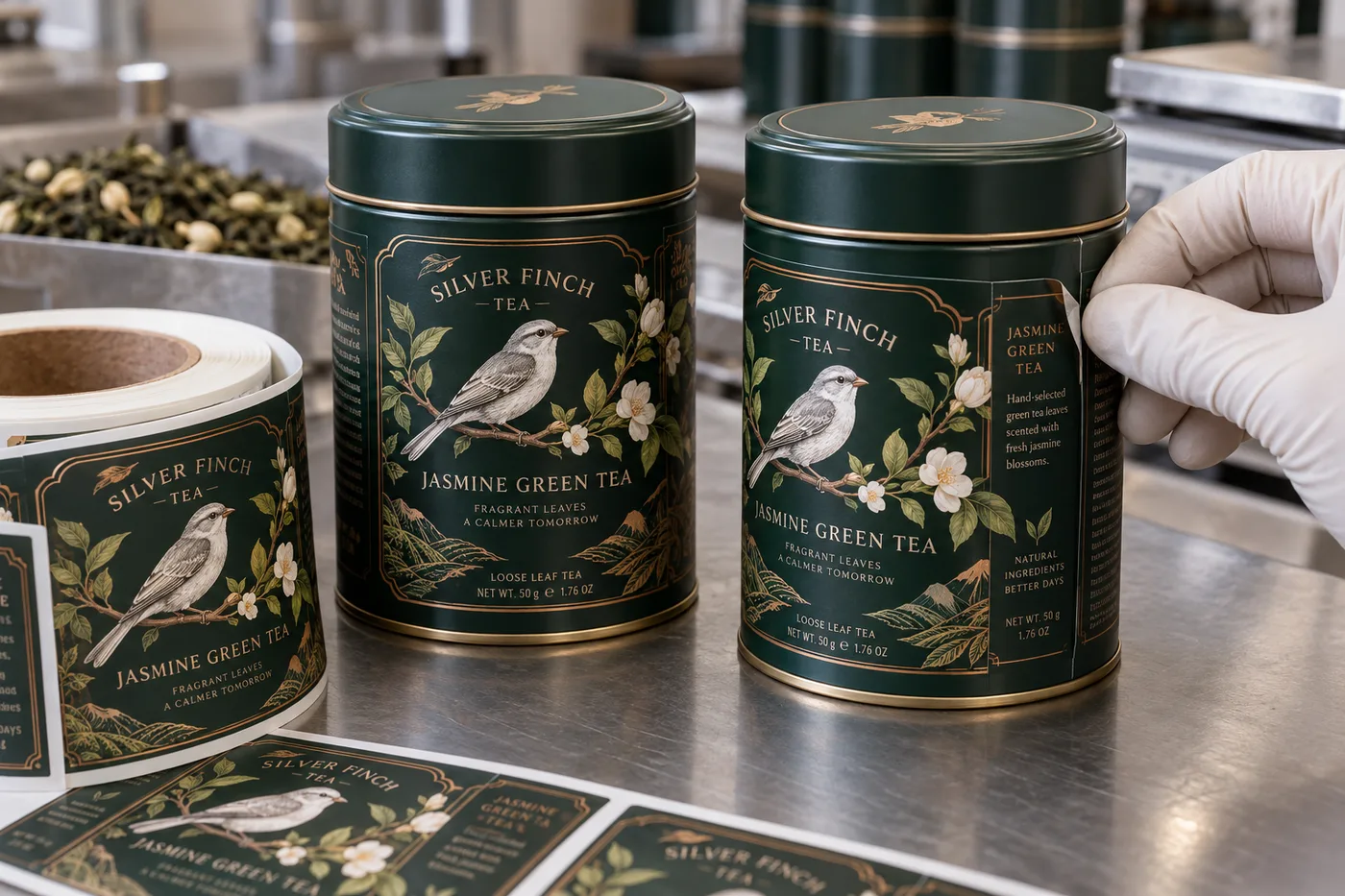
The metal is not the only surface the label touches
A tea tin often arrives with paint, lacquer or a powder-coated finish. The adhesive sees that coating, not bare metal. If a customer asks whether our standard paper label will hold, I ask for tins from the intended supplier and finish lot. A quick hand test on an uncoated sample tells us little.
HERMA identifies tea tins as a useful application for short- and medium-run labels, while its curved-surface guidance emphasizes pliability and adhesive choice. Neither source replaces a trial on this tin.
Two tea ranges, two different compromises
Imagine a composite gift-tea brand with a wide tin and a low-volume seasonal print. A textured paper front label can be attractive, but I would keep it within a broad, stable panel and away from the lid lip. The buyer may get the premium look without asking a stiff stock to make a complete tight wrap.
A composite refill-range brand uses a narrower cylinder and machine application. It may prioritize a flexible film with a controlled end joint. I would compare real tins after filling, capping and opening. If the edge flags only after repeated handling, a stronger initial tack is not the only variable; label stiffness and finish also deserve a look.
Map the useful circumference and lid movement
Measure the straight sidewall between base roll and lid clearance. Check for a vertical metal seam, embossed mark or change in coating gloss. Put a paper size strip on several tins, then rotate them under shelf light. A label that reaches the lid can scrape when customers open the tin; leave a deliberate separation unless the package is designed as a seal.
| Symptom | First question | Trial direction |
|---|---|---|
| End edge flags | Is the material too stiff for the radius? | Compare flexible face and end joint |
| Only one tin color fails | Did the coating change? | Test each finish lot |
| Label rubs at lid | Is there enough lid clearance? | Lower or shorten the label |
| Print scuffs in gift boxes | Is the finish protected? | Test varnish or laminate |
Approve appearance and opening together
Use printed samples on filled tins, not just blank labels on flat metal. Pack them in the intended gift box, handle them, then open and close the lid several times. Photograph the same label edge before and after. The illustrated Silver Finch tin here is fictional and does not document a customer test.
Our buying view
Let the tin determine the premium finish
I like the look of textured stock, but I would not sell it as a default for every narrow tin. A slightly simpler flexible face that sits cleanly may feel more premium to a buyer than a luxurious sheet whose edge curls on the shelf.
Send these samples before quotation
- Tins in every planned coating and diameter.
- Lids, boxes and any security seals.
- Desired label size, finish and artwork versions.
- Hand or machine application details.
- Acceptance after packing, handling and repeated opening.
For the small-radius mechanics, see small-container label flagging. For material selection, compare paper and film labels.
Frequently asked questions
Will any permanent adhesive hold on a tea tin?
No universal answer applies to every lacquer or powder coating. Test the exact tin finish and application process.
Should the label cross the lid seam?
A sidewall label should not interfere with opening unless a separately designed seal is intended and approved.
Is a textured paper label a good choice?
It may suit the visual brief, but check conformability and handling on the tin before choosing it over a more flexible construction.
Related buyer guides
Review your label specification
Send package photos, label dimensions, material details, quantity and application conditions. Include good and failed samples where possible so the discussion starts with evidence.