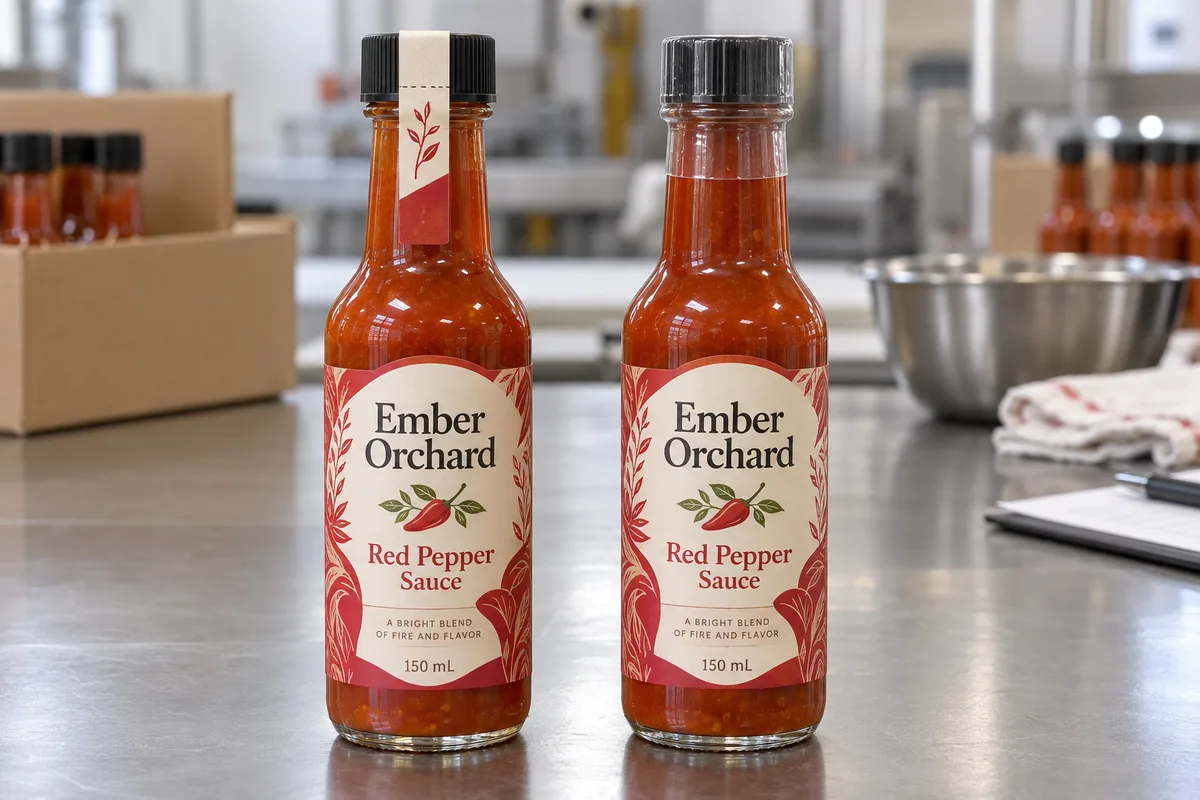
Start with the closure mechanism
A printed strip can carry brand color and fit into the same label procurement conversation. A shrink band can cover more of the cap-neck junction. Neither option proves a product is safe on its own. The useful question is whether an ordinary first opening visibly changes the feature on the exact cap, neck and bottle combination.
Imagine a composite small sauce brand switching from one screw cap supplier to another. The label artwork is unchanged, but the new cap has deeper ribs and a different skirt height. A narrow paper strip that looked neat on the old cap may bridge poorly or tear during application. I would get the final closure before pricing the seal.
Printed strip: compact branding, tighter fit tolerance
A cap-to-neck strip can be applied with a pressure-sensitive label roll and may be attractive for a small specialty run. It needs a clean landing surface on both sides of the opening line and a deliberate break point. The strip should not hide required information or turn the main front label into a crowded patchwork. Test removal with dry, oily and damp hands.
If a strip simply peels off intact and can be reapplied, the buyer should not describe it as a meaningful tamper indicator. I would document the observed opening behavior and ask the food-safety team to decide what claim, if any, is appropriate.
Shrink band: wider coverage, another line operation
A clear or printed shrink band can span the cap and neck without relying on a tiny adhesive landing zone. The trade-off is a separate sleeve and heat application step, plus checks for distortion and removal. It may be the cleaner choice when the cap shape defeats a narrow strip, but it is not automatically cheaper once equipment time and waste are included.
The FDA's consumer guidance on food tampering tells buyers to check outer seals and anti-tampering devices. That guidance supports the importance of visible evidence; it does not certify either of these illustrative bottle designs. Regulatory and food-safety claims need their own review.
Run a first-opening test before ordering
Pack a short run using the intended filled bottle, final closure torque, real cap supplier and production method. Open bottles from different positions in the carton. Check whether the feature breaks visibly, whether it can be removed without evidence and whether the main product label remains readable. Repeat after the normal shipping and storage cycle.
Send bottle and cap samples, neck dimensions, closure type, front-label die line, expected line speed and whether a heat tunnel is available. My buying view is simple: choose the option the line can apply consistently and the customer can understand at first opening. The prettiest seal is not enough.
Our buying view
What we would decide first
Choose the opening-evidence feature with the finished cap and line, not from an artwork mockup. A short trial on the actual pack can settle that question before a full printed roll is ordered.
Related buyer guides
Frequently asked questions
Does a printed cap strip replace a shrink band?
Sometimes, but the strip must fit the final cap and show a clear change on opening; test rather than assume equivalence.
Is a shrink band automatically tamper-proof?
No. It can provide visible opening evidence when correctly designed and applied, but the finished package must be evaluated.
Review your label specification
Send the real package, dimensions, order quantity, labeling stage, storage conditions and artwork. We can discuss a practical material and proof route.