A purchase of 100 labels does not necessarily provide 100 saleable packages. Some labels may be used for setup, fit checks, destructive observations, photography or retained reference samples. A pack may also need more than one separate label.
Choose the trial quantity from its planned uses and label components, then ask the supplier to confirm the actual minimum and format. The number 100 in this page's historical URL is an example, not a standing supply promise.
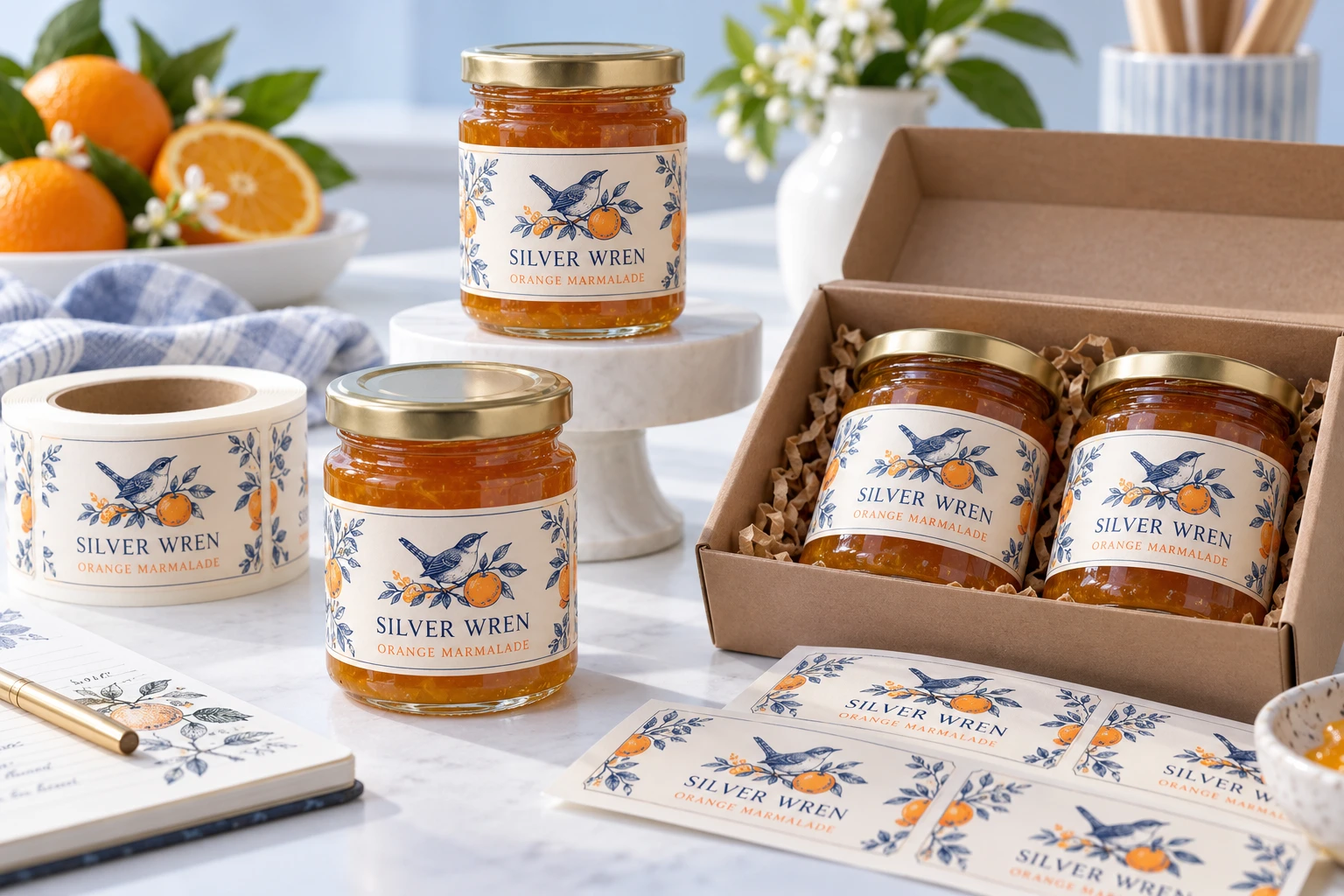
AI-generated packaging planning example. Silver Wren is fictional; this is not a customer job, security proof or measured test.
Name the purpose of each group
Start with the intended business decision. Is this order for package-fit approval, material observations, buyer samples or an actual launch? A small trial can inform several decisions, but the team needs to know which labels will be consumed and which will remain usable.
| Planned use | Allocation to confirm |
|---|---|
| Setup and application practice | Labels required by the actual packer or equipment owner |
| Fit and construction checks | Samples for each relevant package/condition combination |
| Destructive or opening checks | Pieces that cannot later become saleable packs |
| Photography and buyer samples | Packs reserved for presentation rather than ordinary sale |
| Retained approved reference | Identified samples kept for comparison with production |
| Planned saleable packs | Complete label components required for the intended quantity |
Record SKU, artwork revision and component for every line. A front label, a back label and a closure strip are three components even if they travel under one product name. Ask whether quotation quantities are per component, per complete set or a combined total.
Keep the arithmetic explicit
For an illustrative planning calculation, 40 packs with one front and one back label require 40 of each component before any additional uses are counted. They do not require 40 unspecified label pieces. If ten front labels are consumed in a fit trial, that does not automatically consume ten back labels as well; record what the actual plan uses.
Add the agreed extra uses to each component's requirement. Subtract only stock whose quantity, revision and condition are confirmed usable. Do not insert a generic waste percentage from another line; ask the packer what its planned setup and checks require. The resulting quantity remains subject to supplier format and minimum confirmation.
Decide what the small order cannot establish
A hand-applied sample can help with fit and visual review, but it does not automatically represent a continuous automatic packing run. A desktop printout can check copy and scale without proving the final stock or finish. Tie each intended decision to a relevant sample rather than claiming that a single low-quantity order validates every production condition.
If the budget or available quantity cannot cover the plan, reduce the scope deliberately or request a different trial arrangement. Do not quietly take labels away from a required check to complete a photo shoot, or assume that presentation samples can later serve as untouched retained standards.
Carry the result into the next order
After the trial, record what was approved, what changed and which conditions remain untested. Keep the actual construction and artwork references. An order number alone is not enough if the trial used several candidate stocks.
The multi-SKU planning guide addresses range allocation. The quote baseline guide addresses comparable commercial scope. The proof-scope register keeps trial and artwork approvals distinct.
What a small physical trial can contribute
A final-size sample can reveal package fit, visual hierarchy and the relationship between the dieline and the usable panel. A sample made on the intended construction can also contribute to agreed application and handling checks. Identify the actual material and sample limits; an artwork printout is a different deliverable.
Short quantities can reduce the amount committed while a design is still changing. They can also carry a different unit cost and may not be available for every stock or finish. Ask for the actual offered scope. Low quantity by itself says neither high quality nor low quality.
Keep every candidate identifiable
If several stocks or finishes are supplied, label the trial records so that observations can be traced to the correct candidate. Keep an unused sample and the relevant file reference where practical. A later reorder should name the chosen construction rather than ask for whichever trial roll happened to be used first.
If several artworks share a small order, confirm quantities and grouping conditions explicitly. Shared size, stock or finish may simplify a proposal, but does not establish a standing supplier policy. Obtain the offered allocation before relying on a combined total.
Assign a decision owner before consuming samples
The person requesting a photography pack may not be the person approving the label on the line. Put an owner and completion record beside each trial use. Before applying the last samples, check which decision still needs evidence and whether an untouched reference remains available.
If a candidate is rejected, record the reason and keep it distinguishable from the selected construction. A later supplier discussion should not rely on a bag of mixed loose labels whose material identities are lost. If the trial is inconclusive, say which condition or sample was missing rather than marking the full order approved.
Send the relevant project details
Ask about a defined small trial order with the package, label sizes, quantities per component, candidate construction and trial-use sheet. State which decision the trial must resolve. The form opens an email draft; use listed email or WhatsApp for files. Ask the supplier to confirm minimums, format, proof scope and charges rather than assuming 100 pieces is available for every job.