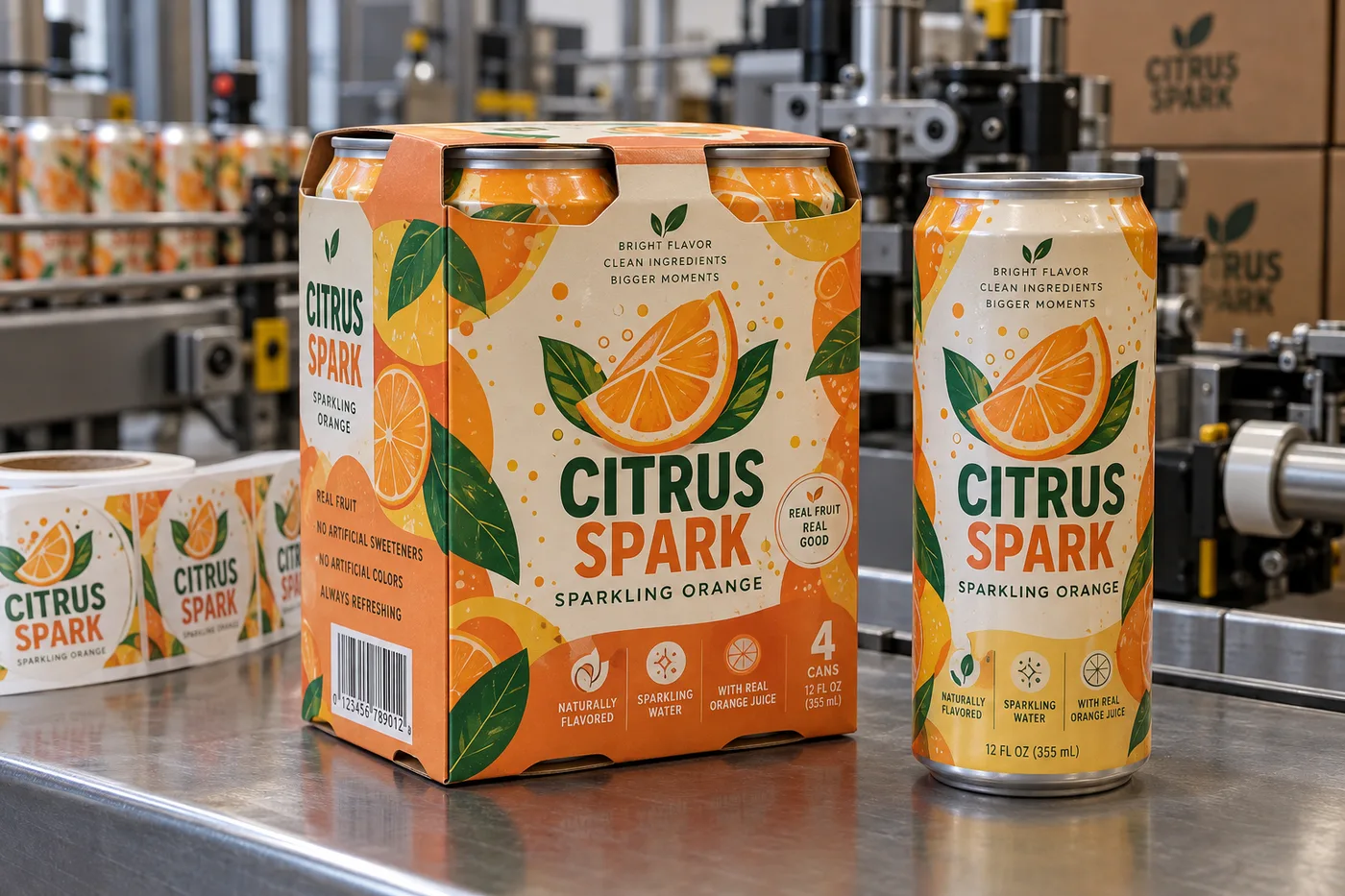
A four-pack is more than four attractive cans
When a beverage buyer asks for a carrier sticker, I ask whether the retailer sells the cans individually, the four-pack, or both. The answer controls which barcode belongs on which level and what the checkout scanner must see. The pack should not look like a random enlarged unit label.
GS1 General Specifications define trade-item identification and barcode rules. The brand must assign and validate its own identifiers for its markets. The rendered code in this article's fictional illustration is decorative; it is not usable retail data.
Two beverage launches with different risks
Imagine a composite local soda brand that sells a four-pack only. It can design the paperboard carrier as the obvious checkout surface and place the pack barcode where the retailer expects it. I would still check that any can barcode visible through openings cannot be scanned accidentally during pack checkout.
A second composite brand sells both single cans and four-packs. It needs a controlled hierarchy: unit identifiers on cans, a separate pack identifier on the carrier, and a line process that applies the correct carrier to the correct flavor. The expensive mistake is not a crooked sticker; it is a beautiful four-pack with the wrong product identity.
Draw the scan view before the artwork proof
Build one packed sample. Turn it as a cashier, warehouse picker and shelf shopper might. Mark visible can codes, carrier folds, glue areas and the flat surface available for the pack symbol. Put the pack information on a stable panel with enough clear space for the final barcode artwork. Verify the symbol after printing and after the carrier is assembled.
| Level | What to confirm | Who signs off |
|---|---|---|
| Individual can | Unit identity and required can information | Brand and compliance owner |
| Four-pack carrier | Distinct pack identity and readable barcode | Brand, retailer or distributor |
| Assembly line | Correct carrier matched to can flavor and count | Co-packer operations |
| Checkout | Pack symbol scans without unintended unit code | Retail testing partner |
Prove both appearance and identity
Ask for a production-like carrier with final stock, ink and adhesive. Check the barcode zone after folding and after cartons are packed. GS1's barcode guide covers symbol choice, placement and print quality; the relevant retailer may add its own acceptance conditions. Do not approve a code merely because a phone camera reads it once.
Our buying view
Identity is a packaging feature
I would settle the pack hierarchy before polishing carrier graphics. A sticker can carry beautiful citrus artwork and still fail at checkout. The right purchase is the printed construction plus a pack-level proof that the brand and retailer actually approve.
Put these items in the multipack brief
- Single-can and pack selling units with approved identifiers.
- Physical cans and fully assembled carrier samples.
- Final barcode artwork supplied by the brand, not invented by the printer.
- Carrier material, application sequence and fold locations.
- Retailer scan or verification acceptance criteria.
For code-quality decisions, read barcode verification versus scanning. Our barcode and QR label guide covers layout planning on other packs.
Frequently asked questions
Does a four-pack need its own identifier?
When the pack is a distinct trade item, GS1 identification rules generally require its own GTIN. Confirm the selling hierarchy and market with your GS1 organization or retail partner.
Can the unit barcode remain visible through the carrier?
That can create a checkout risk when the pack is sold as one unit. Test the finished carrier and retailer scanning process.
Is a phone scan enough to approve the artwork?
No. Use the relevant barcode specification and verification process for the intended retail or distribution environment.
Related buyer guides
Review your label specification
Send package photos, label dimensions, material details, quantity and application conditions. Include good and failed samples where possible so the discussion starts with evidence.