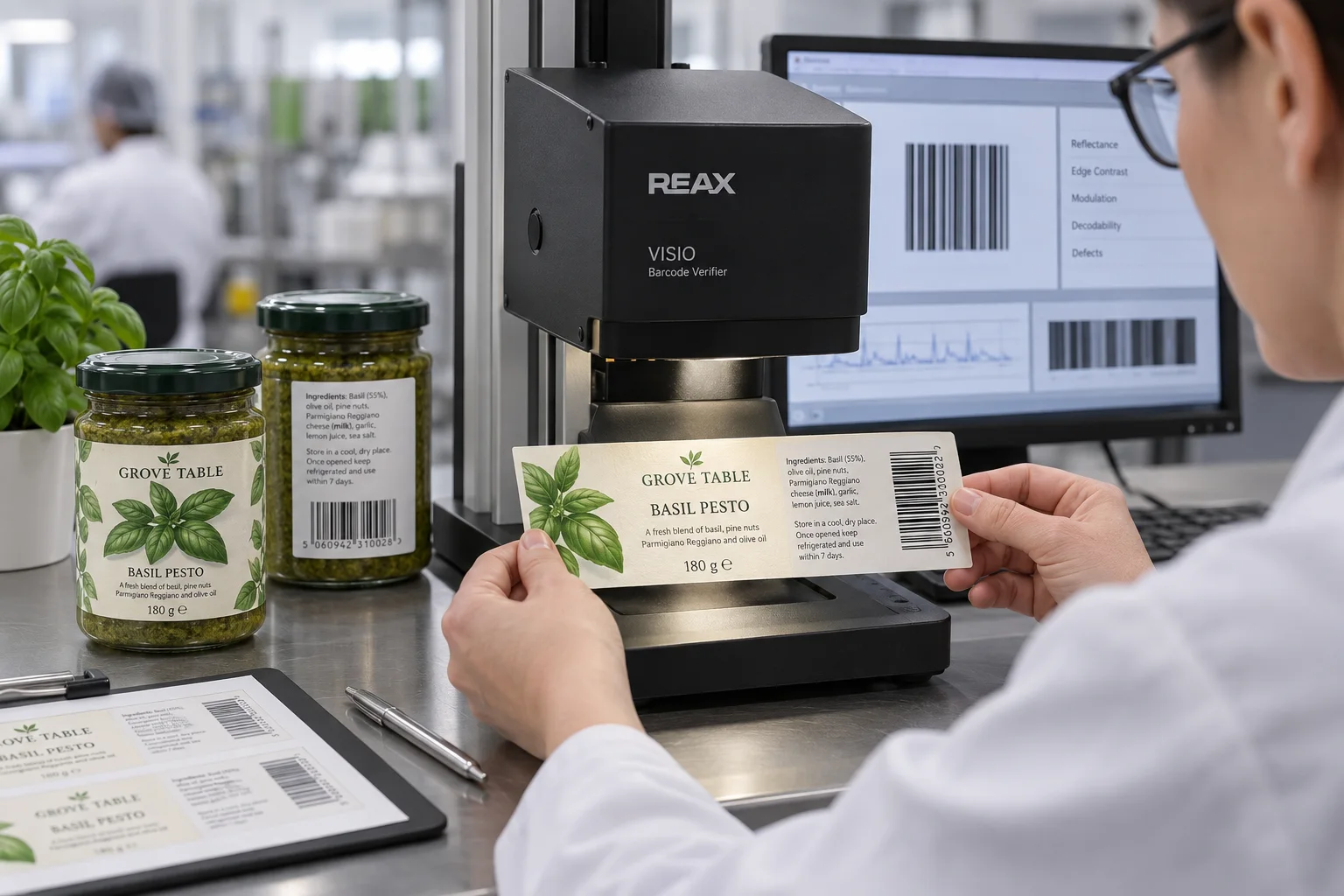
The phone says yes. The purchase order is still incomplete.
I understand why a founder sends a phone screenshot as approval. It is immediate, familiar and free. For checking whether the code opens the intended page or contains the expected number, it is useful. I would keep that check. I would not call it a verification report.
GS1's barcode verification guidelines describe a consistent process for evaluating barcode quality and encoded data integrity. The practical distinction is that verification provides diagnostic information under defined conditions, rather than a single reader's yes-or-no response.
A retailer launch changes the decision
Here is a composite planning scenario. A pesto producer sells directly at weekend markets and checks its jar code with a phone. The same product then receives its first wholesale order. The buyer asks for barcode evidence, and the founder forwards the screenshot. Nobody was trying to skip quality control; the parties were using the word 'tested' differently.
My recommendation would be to get the retailer's acceptance requirement before approving the print order. Do not guess the required grade, symbol size or measurement setup from another brand's packaging.
A second buyer runs an internal stockroom with a fixed scanner fleet and no retail distribution. Its operating test has real value because it reproduces the actual workflow. That does not make a phone test equivalent to formal verification; it means the buying requirement is different. Extra testing should solve a defined risk rather than decorate an invoice.
Separate three approvals
| Approval | Question it answers | Useful evidence |
|---|---|---|
| Data | Is this the intended identifier and product? | Approved SKU-to-code list and decoded content |
| Print quality | Does the produced symbol meet the specified test? | Verification report with method and settings |
| Package and workflow | Does the finished pack work in its intended handling route? | Documented final-pack and receiving-system checks |
These records should point to the same artwork revision. Otherwise a technically impressive report can belong to a sample that is no longer being produced.
Ask for a report that can be traced back to the job
I would request the symbol type, decoded data, sample identification, production date, verification equipment and applicable test method. Include the settings and acceptance criteria appropriate to the symbol and receiving application. Have a qualified verification provider interpret the result if the report is unfamiliar.
GS1's DataMatrix guideline explains that standardized verification and scanning are different: a symbol that fails a quality test can still decode on some readers. Its two-dimensional symbol guidance should not be copied unchanged into a specification for a linear retail barcode.
A supplier saying 'all codes are tested' may mean a camera checks that a mark exists, that a reader decodes it, or that a verifier measures it. Ask which. Those are different services and can have different costs.
Test the label after the important changes
A flat sample is convenient for investigating print quality. The jar on the shelf adds curvature, placement, a seam and the final finish. Ask the verification provider which measurements are feasible on the assembled pack and combine them with appropriate application checks.
My pre-production review would flag a code close to a wrap seam, a clear label whose background depends on the contents, and a redesign that shrinks the quiet area around the symbol. These are reasons to obtain an actual sample, not reasons to declare failure from a screen.
Check the final production construction rather than only an office printout. Keep the code area free of later stickers and date stamps. If the pack will be chilled or heavily handled, agree whether checks after those conditions belong in the acceptance plan.
Our buying view
The report should arrive before the argument
The tempting shortcut is to approve a code because it scans on the nearest device. I would reserve that for the quick check it actually is, then establish the formal requirement before print approval.
Buyers should also resist asking for an undefined 'guaranteed scannable' label. Name the receiving environment and acceptance process. The printer can then quote a service that has a clear deliverable.
A concise barcode acceptance brief
- Identify each SKU, code and approved artwork revision.
- Obtain the receiving partner's current barcode specification.
- Confirm who supplies valid identifiers and who approves the data.
- Agree the verification provider, sampling plan and report content.
- Review final-package placement and any changes after printing.
- Retain production samples and define what triggers a new check.
Our barcode and QR placement guide covers layout planning. For the distinction between copy approval and color approval, read digital proof versus contract proof. The illustrative image here is not a test report, and its fictional barcode is not production artwork.
Frequently asked questions
Is scanning a barcode with my phone enough?
It is a useful content check, but it is not a standardized print-quality verification. Agree the required symbol, test method, acceptance criteria and final-pack checks with the receiving partner.
Should I check the flat label or the labeled package?
Both can be useful. A flat production label helps isolate print issues, while the assembled package reveals curvature, seams, finish and placement effects. Ask the verification provider how to assess the actual package.
Does a verification grade prove the product data is correct?
No. A print-quality result and a correct product assignment are separate checks. Review the decoded data against the approved SKU and applicable GS1 or receiving-partner requirements.
Related buyer guides
Review your label specification
Send package photos, label dimensions, material details, quantity and application conditions. Include good and failed samples where possible so the discussion starts with evidence.
Continue with Beverage Multipack Labels: Keep Pack and Can Barcodes Straight for a focused purchase checklist.