Choose flat-web application when the installed line can register the label to each pack repeat and the complete labeled web can pass through the forming route without compromising the approved package. Choose finished-pack application when a downstream station can support a repeatable panel and upstream integration is unsuitable or unproven. Approve the station before releasing the label outline and roll specification.
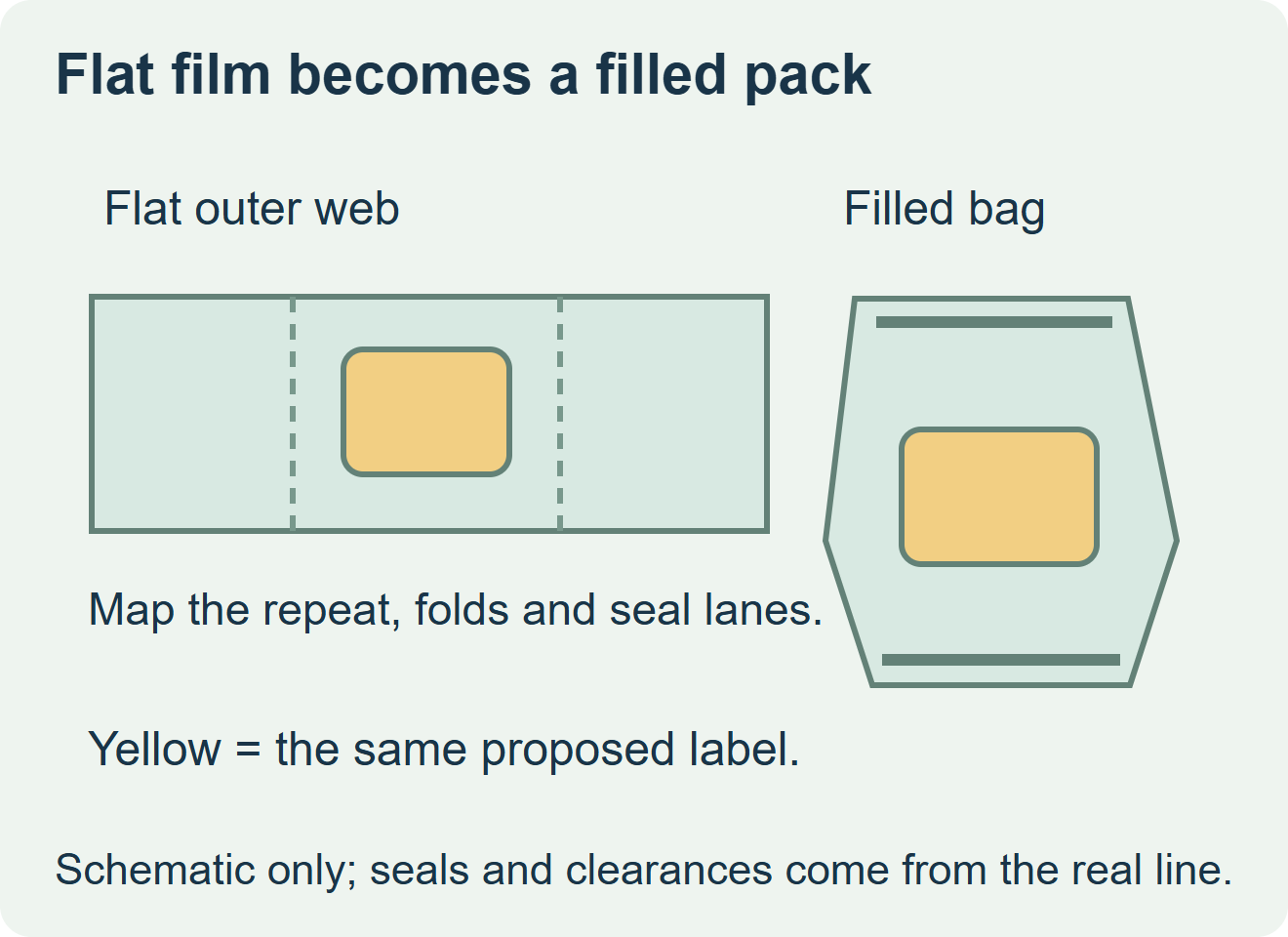
Map one film repeat to one finished pack
Ask the machine owner to show the outer film surface, web travel direction, longitudinal fold or fin seal, cross seals, cut line and the intended visible panel. Transfer the label footprint between the flat-web drawing and a real formed pack. Account for the actual registration and placement variation agreed for the line. A label centered on an unfolded rectangle is not necessarily centered on the bag’s display face.
HERMA describes synchronized label application directly to moving flat film on its VFFS and HFFS systems. Its overview also explains the subsequent forming, filling and sealing sequence. That is evidence of a specific equipment route, rather than proof that an existing packer can add the same operation or run any label stock. HERMA form-fill-seal labeling overview
| Candidate station | What it can help with | What must be demonstrated |
|---|---|---|
| Flat film before forming | A supported surface before the bag acquires its final contour | Registration to the repeat and passage through guides, forming and sealing |
| Finished bag after sealing | Inspection and positioning on the actual filled presentation | Stable product support, accessible panel and repeatable label placement |
| Neither station has a reliable landing area | A different footprint or a packaging-line change may be needed | Revised drawing and a representative trial before a full label order |
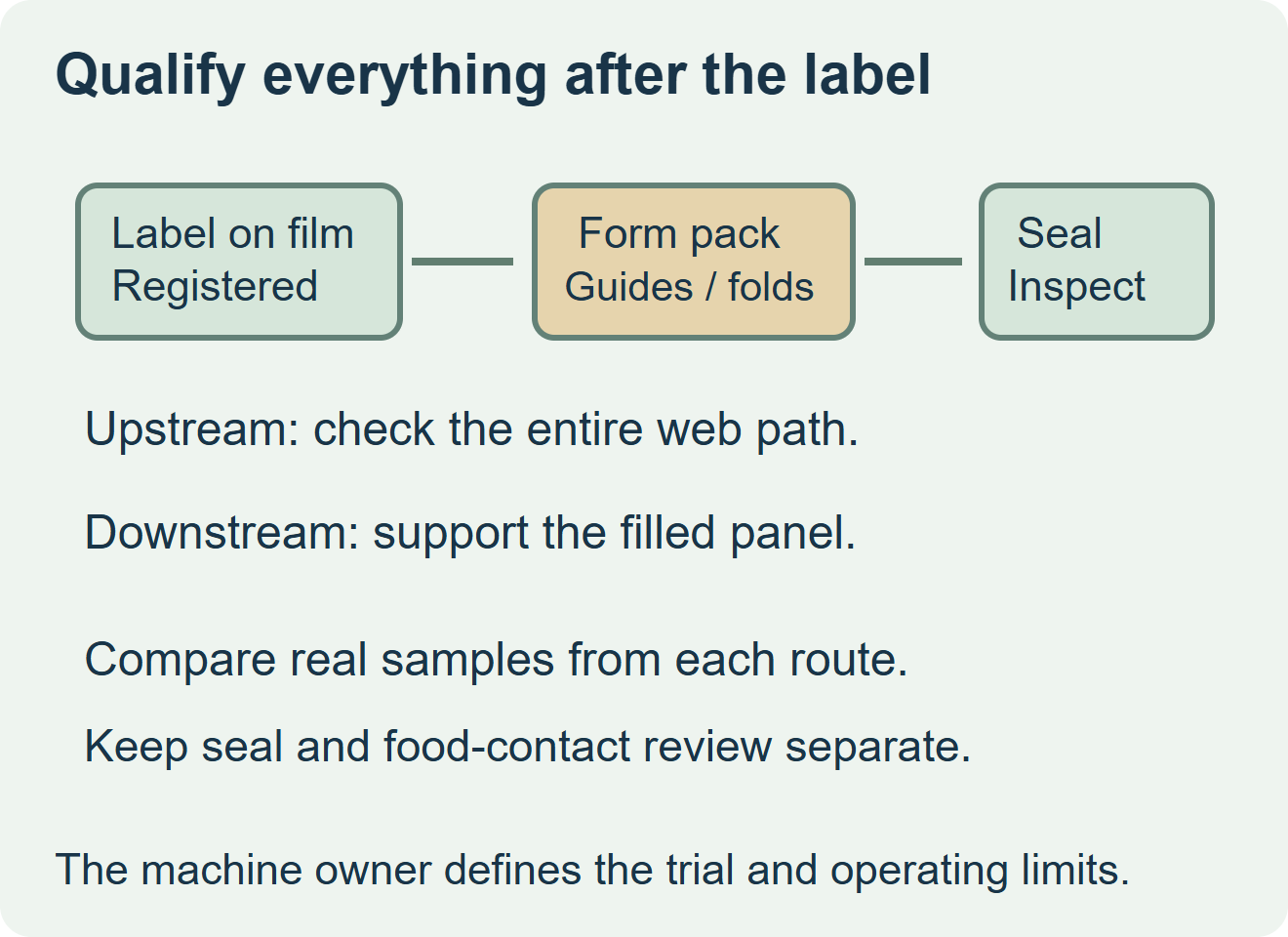
Trial the path after the application point
For upstream labeling, follow the label after it leaves the dispenser. Identify rollers or guides that touch its printed face, changes of web direction, the forming tool, and any region approaching a seal. The machine engineer should define the allowed footprint and construction, including any relevant thickness or stiffness constraint. Check the actual printed and finished label rather than treating an unprinted adhesive patch as equivalent.
Use the line owner’s agreed trial plan to examine registration, wrinkles, edge lift, print damage and the final display panel. Package sealing, barrier performance and any food-contact implications remain with the responsible packaging specialists. A label bonded to the external film must not be assumed suitable for a placement where its face, adhesive or exposed edge can contact food.
Price the downstream alternative as a complete operation
After sealing, the panel may be curved, lightly filled or variable in height. Ask how the station supports and presents it, whether every SKU offers the same contact area, and which film condition the adhesive actually meets. Include orientation, product support and any extra handling in the comparison. The line’s nominal output alone does not establish that labels can be applied reliably at that point.
In a hypothetical snack launch, a flat-web label looks tidy on a loose film sample but crosses the future longitudinal fold. Moving it inward may restore the display panel if the new location remains clear throughout the forming path. If that is impossible, compare a smaller label on the finished bag. Neither route is approved merely because the same label adhered to film on a bench.
Order from the successful route’s specification
Keep the accepted web map or finished-pack placement drawing with the exact film, label construction, trial identity and roll interface. Record which variants were checked and which remain open. A later change to film repeat, bag width or forming hardware needs a review of the map before reusing the label order. The result should be one clear application route and its evidence, not two unqualified options left for operators to solve.
Discuss the unresolved label requirement
Send the exact film and label construction, web travel direction and repeat drawing, formed pack samples, machine and proposed station, seal and fold map, and quantities by SKU. Review food label options and prepare a label specification inquiry. The contact page opens an email draft and lists email or WhatsApp for attachments. Supply, proof options, testing, pricing and timing require project confirmation.